


Sealed vs Ported Loudspeakers: Which is Better?
sealed vs ported - courtesy of dummies.com
This is an age-old question: Which is better? There are certainly points on each side of the argument to consider. The debate of ported vs. sealed is intrinsically relevant and interesting, regardless of the arbitrary brand involved.
When AR (Acoustic Research of Cambridge MA) introduced its original AR-1 acoustic suspension system in 1954 (see figure 1), it represented a quantum leap forward in the advancement of the reproduction of accurate, extended, low-distortion bass from a home loudspeaker. Noted reviewer Julian Hirsch remarked to me that he “knew the industry would never be the same” when he heard the AR-1’s bass.
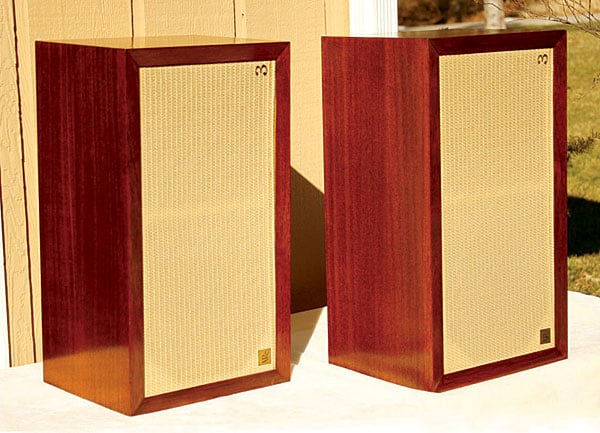
Fig 1 AR-1 of 1954
Using the air trapped inside a sealed cabinet as the restoring force to the woofer cone resulted in a clean, linear response that was a step forward over what existed at the time and is still extremely competitive, even today. The AR-1 (and its famous descendants like the AR-3, -3a, and –LST) had an honest, measurably verified frequency response that was smooth and level down to a minus 3dB point of 35 Hz, with less than 5% THD at that frequency at a 20-watt drive level! There are simply no current passive loudspeakers using just a single bass driver in an enclosure well under 2 cu.ft. that could match that performance, even today.
Not even the big Klipsch’s and Bozaks of the AR-1’s day could reach down to -3 dB at 35 Hz, with less than 5% THD, and they were 4-6-8 cu. ft. boxes. Sealed was a real advancement at the time. Without it, great bass from small boxes wouldn’t have existed, KLH, Advent and EPI wouldn’t have followed AR, and the whole stereo industry wouldn’t have exploded in sales like it did. The smaller box in the living room was icing on the cake (with stereo coming along in 1958, now you needed two speaker boxes), but that’s not what drove Ed Villchur to invent the AR-1. The advancement in bass performance drove AR, not “small box marketing,” as some revisionist historians have opined.
Since then, however, as pure research—led in a major way by Dr. Thiele—and computer technology have advanced through the ensuing years, better ported designs are now possible, to the point where acoustic suspension’s pure performance advantages, such as low distortion and linear response (lack of "boominess") are less apparent. In fact, the trade-offs in greater efficiency and lower 3dB down point often point in favor of a ported approach to system design.
What has changed over the last 50+ years to essentially eliminate this gap? Several factors:
1. Quantifiable, known research and documentation of driver, port, and enclosure parameters, combined with the arrival of fast, economical computing in the commercial corporate environment. Specifically, the work of Thiele and Small in the ‘70’s removed much of the previous uncertainty regarding vented speaker design, and when coupled with the newly available inexpensive computing power, it meant that a new level of speaker design accuracy was achievable. In the 40’s, 50’s and 60’s, designing a vented speaker involved a lot of cut ‘n try guesswork. Designers had to be happy with ‘close enough’ or ‘in the ballpark,’ because the precise calculations needed for optimum outcomes hadn’t yet been done. Sealed designs were more forgiving by nature, and didn’t sound offensive or low-fi when they were less than perfectly done. A poorly done vented system, in contrast, could sound like a bad acoustical joke.
There is a school of thought that points out that the T-S parameters are a bit of a simplification and therefore not fully accurate. A former KEF engineer states:
“The small signal behavior of the loudspeaker can indeed be calculated to better than 95% accuracy from a measurement of the impedance of the loudspeaker. To do this one needs a good model of the equivalent circuit of the loudspeaker system, than do an impedance fit to this model. From that, the equivalent circuit can show the current flow through the components that represent the vent mass and the driver mass, and hence calculate their acceleration. This is the equivalent to the far field response, ignoring cabinet diffraction.
One can then calculate the response from the impedance, measure the nearfield of vent plus driver, measure the inbox pressure, measure the farfield (in a well-calibrated chamber), and get all of these to agree to within 0.5dB down to 30Hz.
However, if it is then converted to T/S parameters, due to them ignoring some of the driver behavior, the result will not be as accurate.
Given that most people who measure the low frequency response do not have access to an anechoic chamber, this is actually a better way for them to get a reasonable idea of the LF performance.”
2. Computer-aided design programs. With today’s design programs, such as Finite Element Analysis (FEA) and 3D modeling programs such as Pro/Engineer, hundreds or thousands of driver/enclosure prototypes can be built in the virtual world of the computer before even one is actually built in the lab. A virtually unlimited number of iterations of magnet structure, cone shape, cone thickness, surround/spider compliance, voice coil length, coil winding, and pole plate variations can be tried and evaluated, before any physical parts are ever used. Different port lengths and geometries can be tried, vibrational analysis can be applied to ‘virtual’ cabinet walls to discover resonant modes and ascertain the structural integrity needed to optimize cabinet design within the cost target of the project. By the time a physical prototype is constructed, it is already most of the way there, with no big surprises.In contrast, in the good ‘ol days of the big bass reflex floorstander, after first trying differing port lengths/tunings, how many iterations and prototypes of the driver itself did they do? Two? Maybe three? Each time, hand-cutting a new pole piece, hand-winding a new voice coil, ordering and waiting for delivery of new magnets….
3. Advanced manufacturing processes and materials. Today’s most advanced loudspeaker manufacturing plants utilize very close-tolerance procedures with advanced adhesives and materials technology that were simply unavailable a generation ago.
It’s interesting to note a few basic factors that still fuel the sealed vs. ported issue, even today. At low frequencies, increasing SPL requirements demand ever-greater woofer excursion from a sealed system, which limits output and can increase distortion. In a properly tuned vented system, the port is providing the majority of low-frequency output, and the driver’s excursion—and hence its distortion—is very low.
The upshot of all this is that today’s speakers can be much better performers than yesterday’s if the company and/or designer so chooses. The blueprint for excellent performance is better known than it was in years past, and a skilled designer with clear, worthy goals working with today’s best tools can achieve astonishing performance at incredibly modest prices. It’s less a question of whether to take Sealed Avenue or Ported Road, and more a question of what you’ve chosen as your destination.
Measuring Ported Speakers
Ported speakers are by their very nature more difficult to design properly, and even more important, can be extremely difficult to measure, as demonstrated by Don Keele in his 1973 paper to the AES entitled “Low-Frequency Loudspeaker Assessment by Nearfield Sound-Pressure Measurement”. The engineer must measure the contributions of the port and woofer separately, and then correctly weigh their outputs, taking into consideration the ratio of their radiating areas and the overall system tuning. For example, if the diameter of the port is one-half the effective piston diameter of the woofer, the port’s output must be reduced by 6dB relative to the driver’s measurement before their outputs can be summed. (See figure 2 for an example of a well-designed early-‘70’s ported loudspeaker, the JBL L-100.)
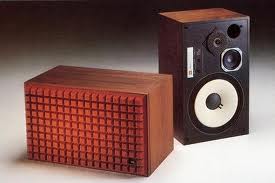
Fig 2 JBL L-100 of 1972
This produces a complex composite curve of the system’s overall far field
low-frequency response. The system’s response must then be verified by
double-checking with other measurement techniques such as placing the
microphone in the near field equidistant between the port and the woofer. If
the port and woofer are on the same surface—which is often the case—it can be
impossible to reliably measure the separate woofer and port contributions
without severe crosstalk between the two. Poor sounding ported speakers are
often the result of something as infuriatingly simple as the engineer measuring
and reacting to the wrong data. Designing good speakers is not easy stuff, and
as much as most avid hobbyists would like to think they have it all figured
out, they don’t.
A parallel situation occurred recently when someone asked me why oval speakers sounded worse than round speakers. My reply was that oval speakers don’t have to be inferior per se to round drivers, they just end up being worse for reasons totally unrelated to their ultimate design potential. If my friend has heard bad-sounding ovals in the past, he's probably right, but not for the reasons he thinks. They're bad simply because they were poorly designed drivers. Maybe they were intended only as rear-deck original equipment speakers in a Chevy Caprice, where ultimate audio quality was not the primary goal. So the speaker didn't have an optimized cone profile to reduce destructive resonances. It’s surround didn't allow long, linear excursion, the voice coil couldn't handle much power so its distortion was high, etc.
This would certainly lead to a bad-sounding speaker. The fact that it was oval is coincidental. But since the oval shape fits in a lot of places where high-fidelity is not a priority (tablet computers, the thin side bezel of a 15” LCD TV, standard-issue factory car audio systems, etc), it's natural to begin to associate "oval" with "low-fidelity." (See figure 3, a cheap oval ‘all-purpose’ speaker.)
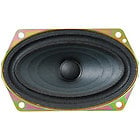
Fig 3 Cheap all-purpose oval speaker
This is specious logic. There is no automatic cause and effect. There is nothing that says the shape of a driver is the sole or even the primary determinant of sound quality. The original Infinity EMIT tweeter was a 3 x 5" rectangle (see figure 4), but it sounded great.
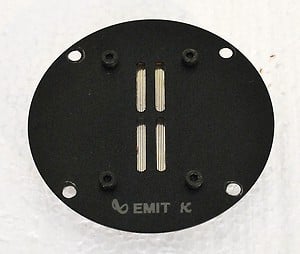
Fig 4 Infinity 3 x 5 EMIT Tweeter
The oval 9 x 13" KEF B139 “racetrack” bass driver of the 1970's was a great woofer (see figure 5).
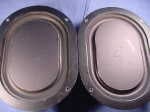
Fig 5 KEF 9 x 13” B139 “Racetrack” woofer
Martin-Logan electrostatics are long and rectangular (see figure 6), but do they sound airy, natural, and transparent? They sure do, and they're not round.
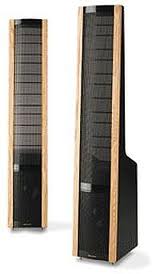
Fig 6 Martin-Logan electrostatics
If
it rains three Tuesdays in a row, does Tuesday cause the rain? No, it's just a
coincidence. The weather conditions cause the rain, not the day of the week. If
you hear three bad-sounding speakers, is it because they're oval or rectangular
or round? No, it's because they're just bad speakers.
Similar reasoning can be applied to ported speakers. If you hear a series of
bad ported speakers, it’s natural to associate boomy, floppy bass with ported
design. But this isn’t necessarily the case. If the designer is good, if he
uses the proper measurement techniques, if the system is tuned correctly, if
the driver has the appropriate electrical and mechanical parameters, then a
superb system can be produced. That’s a lot of “IF’s”, and it’s much trickier
to do it well than with a sealed system. As I’ve said before, if you miss by a
little in designing a sealed system, you’re still ok. If you miss in a ported
system, welcome to Boomy, One-note City. My own feeling is that the lower 3dB
down point of a small ported system and its higher efficiency are thought by
many companies to be worthy advantages in today’s less critical, less
hobbyist-driven audio environment. When Mr. And Mrs. Gen X/Y’er wander into the
Big Box Mass Merchant and listen to speakers, chances are they’ll be impressed
with the one that has more “bass” and plays louder. Those are bad ported
speakers. The point is, they don’t HAVE to be bad.
Now I’m going to completely contradict myself and go against all this carefully laid-out reasoning I’ve just spewed forth. There was an intriguing article by the late Peter Mitchell in the December 1995 issue of Stereo Review on the subject of group delay in loudspeakers. Group delay is a measure of how sharply the phase of a signal changes with frequency. Mitchell was an acclaimed audio expert, reviewer, and commentator whose views and writings were very highly regarded. He was a founding member of the nationally-known Boston Audio Society. I remember he caused quite a stir at a Bose press conference several years ago with his pointed, relentless questioning and was summarily banned from all future Bose press events. His passing several years back was quite a loss for the audio enthusiast community.
Bass Reproduction & Group Delay
In this article, Mitchell puts forth the idea that there is a definite
correlation between the subjective quality of bass reproduction and superior
group delay performance. Speaker systems can be thought of as minimum-phase
filter devices, so the magnitude response (amplitude vs. frequency) of a
speaker will determine its phase, time (impulse) and group delay
characteristics. All things being equal, sealed speakers (2nd -order high pass
filters) have superior (lower) group delay characteristics than ported or
bandpass systems (4th - or 6th -order high pass filters). As Mitchell’s article
states, “Sealed-box…speaker systems consistently have the least group delay
(under 10 milliseconds), and they usually deliver the tautest bass transients,
the deepest-sounding bass tones, and the most clearly resolved bass textures.
Bass reflex and bandpass systems often exhibit substantial group delay [in
excess of 50 milliseconds]…and their sound tends to be thicker, fuller, and
‘slower’.”
This is very thought-provoking, and goes a long way to explaining why the “tightness and crispness” of the bass of an acknowledged “perfectly done” acoustic suspension system like the classic AR-3a/AR-LST (see figure 7 and 8), or AR-9 with dual 12-inch woofers (see figure 9) seems so much better than many other systems’.
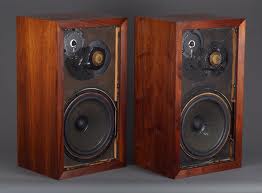
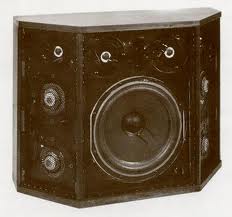
Fig 7 AR-3a Fig 8 AR-LST
Note, however, that there are lots of factors that are not “equal.” The system designer has many choices. How he chooses to damp the system affects the magnitude response, and thus affects all the other factors, including group delay. An under-damped sealed system will exhibit poorer group delay characteristics than a properly-damped ported system.
There is of course the camp that believes that well-designed vented systems are superior. If well-executed they have many benefits, but a lot of the time they are not well-executed.
The “other side of the coin” continues: “The supposed benefits of lower group delay of closed boxes is rarely the reason why vented boxes sound different from closed boxes, since this relies on linear theory, where of course loudspeakers are rarely linear at low frequencies. It is the effects of non-linearities that mostly influence our impression of the bass from typical loudspeakers.
It could be argued that the benefits of extended bass of vented over closed is actually of more benefit, as, although the ultimate group delay may be higher, it is deferred to a lower frequency where it is of less audible importance.
Additionally, the earlier roll-off of a closed box changes the nature of the sound of the instruments, and this can definitely change ones impression of the sound of the instrument. By suppressing the strength of the fundamental compared to the harmonics (because of the earlier roll-off), the apparent timing of the instrument changes, with the harmonics "exploding" sooner than the fundamental. Therefore, the musical pace seems to quicken, and the transients become quicker. Some musicians know this instinctively, and a bass player might know to pluck the string earlier as he descends the register in order to maintain the timing of the music.”
The sealed box AR-3a and AR-LST have a Q of .707, which is optimally damped. The AR-9 has a Q of .5, bordering on critically damped. The choice of these Q values by the designer results in a very flat, non-peaked response down to the system’s –3dB point, which implies a very low group delay. The 9 actually begins to roll off a little before its 3dB down point, but it’s an excellent design choice, because the 9’s natural 3dB down point is so low anyway (an honest 28 Hz!) by virtue of its two 12-inch drivers’ 18Hz free-air resonance and the amount of bass energy the system produces with that big enclosure (a floor standing cabinet of over 4 cubic feet). By choosing a Q of .5 the designers have elected to intentionally “throw away” a little bass energy—which they can easily afford because the 9 has so much to begin with—in exchange for super tight, clean bass. A lower Q means greater damping, and lower group delay.
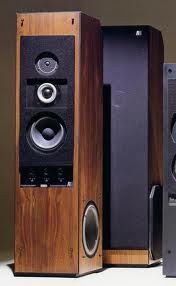
Fig 9 AR-9
This notion of low group delay is also presented by another well-respected source, Siegfried Linkwitz on his website linkwitzlabs.com. In a feature entitled “Frontiers,” in section F under the heading “Group delay and transient response,” he states: "…I am not certain what happens in the range below 100 Hz and I have strong suspicions that this is the region where delay distortion is audible. It is also the region where delay really accumulates via vented and bandpass woofers, and the great numbers of dc blocking capacitors in the signal chain from microphone to speaker terminal."
Conclusion: Sealed vs Ported Speakers, Which is Better?
So who knows? Maybe sealed is inherently better. Or maybe we’re just not measuring the right data. But I have heard terrific (and lousy!) systems of all types, so I'm willing to believe that it's more a matter of the designer's goals and their skill at execution that makes the difference, rather than any arbitrary design approach. What do you think? Tell us your opinion in the dedicated forum thread for this article below.
Steve Feinstein is a long-time consumer electronics professional, with extended tenures at Panasonic, Boston Acoustics and Atlantic Technology. He has authored historical and educational articles for us as well as occasional loudspeaker reviews.
View full profile Subscribe to our newsletter