


THX Video Calibration Training Class Review
THX Video Calibration Training Class
- Product Name: Video Calibration Training Class
- Manufacturer: THX
- Performance Rating:

- Value Rating:
- Review Date: April 28, 2009 01:35
- MSRP: $ 1995 (was $2700)
Obtain the Video Calibration Certification
Three instruction days, including two days of coached hands-on calibrating exercises
Exposure and practice using a variety of the world’s best display devices and measurement equipment
Access to the exclusive THX Video Calibrators' forum and extranet, which provides service menu data and calibration advice directly from THX professionals
Your services and certification listed on the THX.com Web site
Have access to use the coveted THX Certified Professional Video Calibration logo
Offer your clients Professional THX Certified Video Calibration services
A free demo DVD from THX
CEDIA CEU Credit - 8.00 units (CEUP347)Pros
- Lots of hands on
- Lots of different equipment available
- End up THX certified with all the perks that implies
Cons
- Some topics could have been covered in greater detail
- Using the different equipment wasn't made simple
- Certification test needs work
- Expensive
THX Video Calibration Overview
 Calibration
of displays is something that not many consumers know much about. Their
expectation is that they buy a display, take it home, and plug it in. At this
point they are done - or so they think. The next thing you know, they are
telling their friends that HD isn't all that great and they never should have
spent all that money. Is it true? Not by a long shot. Instead, what they have
is a display set in "torch" mode giving them all sorts of artifacts,
edge enhancement, and oversaturation of colors. Can this be fixed? Sure, but
many don't have the expertise or confidence/motivation to figure it out for
themselves. The only thing to do is to hire a calibrator. But which one?
Calibration
of displays is something that not many consumers know much about. Their
expectation is that they buy a display, take it home, and plug it in. At this
point they are done - or so they think. The next thing you know, they are
telling their friends that HD isn't all that great and they never should have
spent all that money. Is it true? Not by a long shot. Instead, what they have
is a display set in "torch" mode giving them all sorts of artifacts,
edge enhancement, and oversaturation of colors. Can this be fixed? Sure, but
many don't have the expertise or confidence/motivation to figure it out for
themselves. The only thing to do is to hire a calibrator. But which one?
Imaging Science Foundation (ISF) has long been certifying calibrators but the fact is that, outside of the industry, those three letters mean next to nothing. That doesn't mean that people can't be informed about ISF. On the other hand, what they do understand is THX. They see it at the theater, in funny clips before movies, and on some of their home theater equipment. They may not know exactly what it is but they do recognize that THX stands for some form of quality. It very well may be that a calibrator with THX behind their name might have the edge with some consumers.
Training Overview
 The real question that should be asked
before you consider a training class like the THX Video Calibration training is
if you really need it. If you are looking for an additional source of income
and you live in an area that has a large enough population that might have need
of your services, then this training course might be what you need. The fact is
that there were people in the class that were just enthusiasts. Guys that are
really into this sort of stuff and want to know everything they can about it.
There were professionals looking for extra credentials, and, of course, a
couple of reviewers (Clint DeBoer
and myself, plus Mike Osadciw from Home Theater Forum) who were there to hone
our skills and perhaps learn a few new tricks. At nearly $3k not including
expenses, the THX training isn't exactly pocket change (at least not for anyone
I know) but it may be worth it depending on your situation and desires. And
remember, it isn't unusual for someone to spend that amount on a couple of days
of vacation. If your idea of a "vacation" is playing around with
video equipment and learning a marketable skill… well, you've probably already
signed up for the next training in your area.
The real question that should be asked
before you consider a training class like the THX Video Calibration training is
if you really need it. If you are looking for an additional source of income
and you live in an area that has a large enough population that might have need
of your services, then this training course might be what you need. The fact is
that there were people in the class that were just enthusiasts. Guys that are
really into this sort of stuff and want to know everything they can about it.
There were professionals looking for extra credentials, and, of course, a
couple of reviewers (Clint DeBoer
and myself, plus Mike Osadciw from Home Theater Forum) who were there to hone
our skills and perhaps learn a few new tricks. At nearly $3k not including
expenses, the THX training isn't exactly pocket change (at least not for anyone
I know) but it may be worth it depending on your situation and desires. And
remember, it isn't unusual for someone to spend that amount on a couple of days
of vacation. If your idea of a "vacation" is playing around with
video equipment and learning a marketable skill… well, you've probably already
signed up for the next training in your area.
Let's get past the "if" you're there; let's talk about whether or not you should be. As I mentioned, ISF has a similar course. While I haven't taken it, Clint has and will weigh in on the differences at the end of this article. But don't kid yourself and think that this sort of class is just for industry professionals. At the beginning, they asked everyone to introduce themselves and it seemed that about 1/3 to 1/2 of the people were just enthusiasts or non-professionals. These were guys that were just really into video and thought that maybe they might be able to make a little money on the side with it. Clint and I were pretty surprised as we thought we'd be surrounded by professional calibrators.
The breakdown of the class looks like this:
- Day One
- History of Television (brief)
- Why We Calibrate
- What Makes a "Good" Image, Just Noticeable Differences (JND), and Video Performance
- Signal Path and Optimization Strategies
- Calibration Process
- Contrast Ratios and Screen Uniformity (Lab #1)
- Geometry & Convergence
- Contrast and Brightness (Lab #2)
- Color, Tint and Color Decoding (Lab #3)
- Sharpness and Enhancement Controls (Lab #4)
- Day Two
- Calibration Process and Integration of Signal Generators
- Grayscale and Gamma
- Software and Hardware Choices (Lab #5)
- Competing Display Technologies
- Hands-On Grayscale Calibration with Different Technologies (Lab #6)
- Overview of Front Projector Setup, Hands-on Training, Keystone and Other Geometry Corrections & Screen Technologies
- Scaling Technologies
- Day Three
- Processing Issues; Progressive/Interlace
- De-interlacing with Examples from HD and DVD Benchmark Discs
- Environmental Issues
- Color Science and Color Standards Including Color Gamut (CCA and CMS) Management
- Approach to Calibrating CCA and CMA … Examples of Different Systems (Lab #7)
- Day & Night Modes (Lab #8)
- Calibrating to Black & White Films
- CRT Calibration Items
- Online Exam & In-Field Calibration
- Summary & Putting it All Together
Day one is actually pretty free of hands on while days 2 and 3 have lots of hands-on time. Each day they provide a lunch (and there was a continental "breakfast" at the hotel it was held at though I don't know that you can expect that at every location). A word about the hotel - it was a hole. Obviously chosen based on price/facilities/convenience, if it is any indication of the types of hotels that THX uses, I'd serious recommend staying nearby. While Clint's room wasn't as bad, you literally had to kick the door open to mine. The cost of the class includes only the lunch (which was Italian every day for some reason) and not the room and board (pretty typical for this sort of class). You'll need to factor in the cost of travel, lodging and food when you are budgeting for the THX Certification class.
 As I mentioned, day
one was mostly background and theory. Even if you've been in the industry a
while, you'll probably hear a few stories or facts that you'd either forgotten
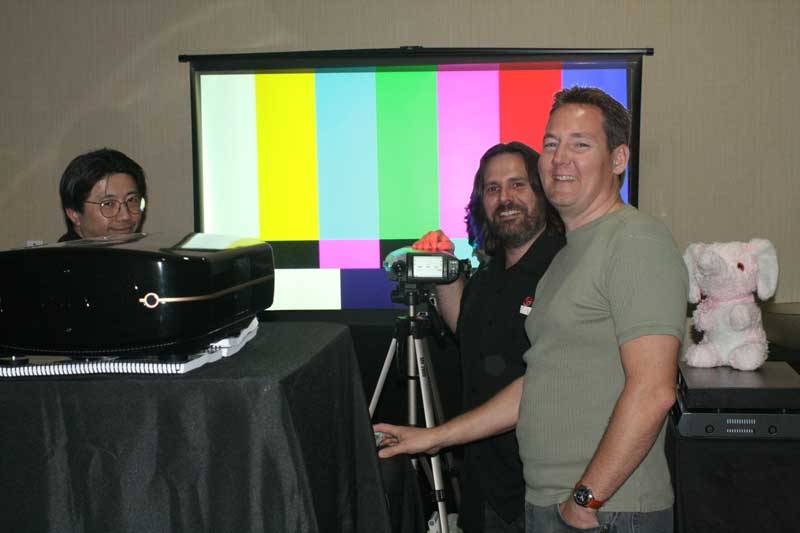
or that are new to you. The two instructors, Gregg Loewen and Michael Chen,
were informative and interesting and mostly held my attention. There is
definitely a drinking game to be made from the number of Star Trek/Star Wars
comments that Michael will make. Just make sure you don't enforce the "I
don’t' remember that one so I have to drink double" rule or you'll
probably end up in the hospital. The duo have done thousands of calibrations
between them and have come across just about every display there is. They are
familiar with most of the calibration equipment on the market and can speak off
the cuff of technology and techniques most would need a stack of books or notes
to reference. They are certainly experienced and knowledgeable. In fact, they
are not just instructors, but working calibrators so you are getting up to date
information on the latest displays on the market.
As I mentioned, day
one was mostly background and theory. Even if you've been in the industry a
while, you'll probably hear a few stories or facts that you'd either forgotten
or that are new to you. The two instructors, Gregg Loewen and Michael Chen,
were informative and interesting and mostly held my attention. There is
definitely a drinking game to be made from the number of Star Trek/Star Wars
comments that Michael will make. Just make sure you don't enforce the "I
don’t' remember that one so I have to drink double" rule or you'll
probably end up in the hospital. The duo have done thousands of calibrations
between them and have come across just about every display there is. They are
familiar with most of the calibration equipment on the market and can speak off
the cuff of technology and techniques most would need a stack of books or notes
to reference. They are certainly experienced and knowledgeable. In fact, they
are not just instructors, but working calibrators so you are getting up to date
information on the latest displays on the market.
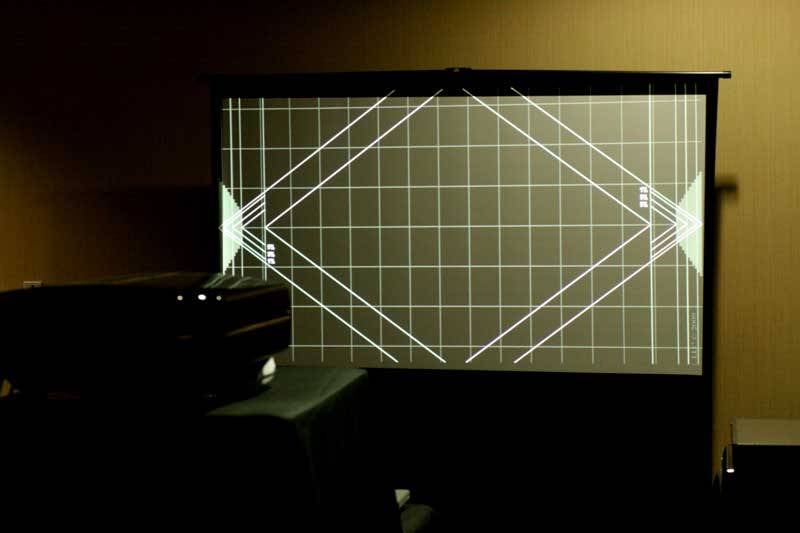
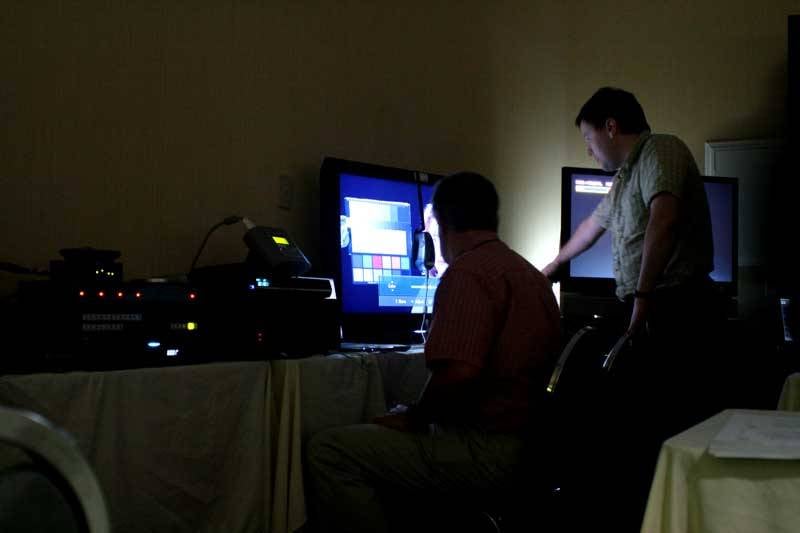
The room we were in was fairly small but it was packed to the gills with displays. There were six flat panels, one rear projection DLP, and four front projectors. There was a wide array of calibration equipment available - more if you consider that everyone was asked to bring in their own kit. While it was neat to see all the calibration equipment, it really wasn't practical to use it. In order to do so, you needed your own laptop (which we had) but also to install and configure the software. While plugging in a USB printer might be a simple (-ish task, depending on whether you're using a PC or not), calibration equipment often takes hours to install and get running correctly. OK, I may be exaggerating a little but it isn't unusual for there to be conflicts. What would have been nice is if they had provided dedicated stations with a laptop and a calibration device paired so that you could get practice not only with the device but the software that was driving it. This would also help the attendees understand the differences between all the meters and software packages so that they could make a more informed decision if they decided to purchase something new. As it was, you had to try and pair up with someone that had brought a piece of gear/software package that you were interested in or risk wasting all of your lab time trying to get something new installed on your computer.
The flip side was that Derek Smith of SpectraCal was on hand with his calibration package and software. Before entering the room, I'd never heard of SpectraCal though Clint had. It's a new company that has developed a new calibration software that seems to be the most flexible and comprehensive on the market. Derek did a small presentation and was there for the entire last day of class to demo his software and answer questions. We spent a lot of time that last day looking over his software package instead of doing our calibrations.
Wasting lab time is definitely not recommended - though learning the SpectraCal software wasn't a waste for us. Part of the requirements to be THX certified is to complete 10 calibrations and to have them verified by THX. With the number of displays at the training, you're not going to want to waste time with hardware/software installations. While Clint and I pretty much handle all the display reviews for Audioholics, 10 is a lot and you only have a year to do them in. If you're not a full time (or at least part time) calibrator, that's a tall order. We thought it best to make sure we took advantage of the displays on hand. Hustling as much as we could, we were able to get 8 done though I'm sure it is possible to get all 10.
THX Calibration Conclusion
The class takes you through the basics first - brightness, contrast, sharpness, color and tint… the stuff you don't need a meter for on the first day. You do get some hands on time during that day as well. Again, there are a number of different signal generators and test disks you can use to do these sorts of calibrations and for the most part they were all available. The downside was that you sometimes needed to ask for help to switch between the different types of sources which slowed down the process. It would have been better if specific displays were paired with specific sources. Instead, they had a video router which could be used but only the instructors knew how to operate.
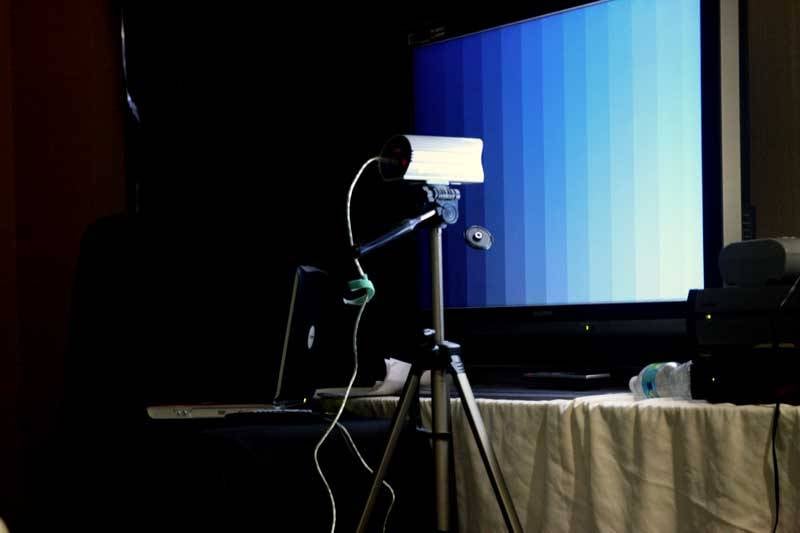 On day 2, we started
to use meters. There was a ton of hands on during this time and we were
encouraged to pair up with other people. This was a really good opportunity to
experience new gear and to ask questions. That evening, after dinner, the
instructors stayed in the room to near midnight as most of the attendees worked
on calibrations trying to get as many done as possible for the requirements. That
was a really big help. The instructors were also always available and willing
to answer questions and give you guidance. During the class times, they encouraged
questions and always had an interesting story on hand to illustrate more
complex concepts.
On day 2, we started
to use meters. There was a ton of hands on during this time and we were
encouraged to pair up with other people. This was a really good opportunity to
experience new gear and to ask questions. That evening, after dinner, the
instructors stayed in the room to near midnight as most of the attendees worked
on calibrations trying to get as many done as possible for the requirements. That
was a really big help. The instructors were also always available and willing
to answer questions and give you guidance. During the class times, they encouraged
questions and always had an interesting story on hand to illustrate more
complex concepts.
By day 3 it seemed that everyone was getting a little tired and overloaded. The instructors completely skipped the CRT section which we appreciated as anyone still teaching about that technology is wasting a lot of time on obsolete televisions. Most everyone that is an old-school calibrator will likely already know what they need to calibrate a CRT. Those that are new to calibration or hobbyists probably won't be running into any. This is also when we covered CCA and CMA - both are specific to projectors. It was at this point that I started to feel like the generalities were getting a little lost because of the specifics. Just about everyone has had the experience of someone that really knows a topic trying to explain it to a neophyte. The experienced person often has so much knowledge that they assume the neophyte already knows the basics. This leads to the neophyte looking confused, nodding a lot, and then asking someone else. While CMA and CCA were covered in great detail, there were definitely times that I felt that the whys and some of the basics were being assumed. It's like going to a woodworking class and having the instructor start with, "Now, grab your planed 2x4…" If you don't know what a planer is then you're already lost.
While it may have been appropriate to skip the section on CRTs, apparently the person that created the final exam for the class didn't think so. After you complete the course, you have 3 weeks to complete and pass (with 85% or better) the final exam online. You can take it up to 3 times and after you take it, it tells you which questions you missed. The test is timed (in a "enter the answers in an hour" not "you've got 5 minutes for 30 questions" type of way) and is 100 questions long. What they suggest (and I did) was open the test, print it out, and fill it in later after you've answered the questions on the paper. This also makes it easy later when it tells you what you missed to correct your mistake. I have no problems with any of this. What I did have some concern about were the questions.
As I implied, there were still questions on CRT calibration on the exam. The first rule of test construction is that you never ask a question about something you didn't teach in the class. If it isn't important enough to cover in the class, it shouldn't be on the test. I personally believe that you shouldn't have any question on an exam that wasn't covered specifically verbally but it is a more common practice to allow questions that are covered in the readings. The problem with this for the THX class was the "readings" were 200+ pages of printed out Power Point. Reading someone else's Power Point slides is often like trying to decipher a code without a key - nigh impossible. Second was the wording. Many of the questions were unnecessarily tricky. "Pick the worst response" was common. While this didn't trip me up as much as it did some others (I did attend grad school in the school of Psychology - talk about unnecessarily complex multiple choice questions), it didn't exactly seem fair for this type of environment. People have paid lots of money to take your class, trying to trip them up on a test seems petty and disrespectful.
On top of that, there were a few questions that didn't make much sense. The entire test was multiple choice and there were answers that didn't line up with the question. The worst was the question "When adjusting gamma it is good to:" with one of the options being the lone word "visually." Um… OK? I think I know what they were going for but come on! I can't believe we're the first one that has complained about this question. The key when creating this sort of test is to read the question with each response and make sure they make sense. Lastly, there were a few questions that Clint and I both felt were either scored incorrectly or that the program that did the scoring was a little glitchy. That might just be user error on our part but we both noticed it.
So, after you complete the class you are required to do 10 calibrations (2 of which need to be done in class so really 8), pass the exam, and pass the level 1 technician class. This is the audio portion which costs another $500 (plus expenses). Luckily, there is a free online component that you can do instead for the Video Calibration class attendees. After you complete all the requirements, you are able to certify that a display is calibrated up to THX standards. What does that mean? It means that you can make a display look as good as it possibly can. In order for the calibration to be complete and for you to provide a THX logo plaque, a letter of certification, and a THX test disk to the client, you'll need to have your calibration certified by THX. To do this, you submit the calibration settings electronically to THX and they will send the client all of the above. This is their way of making sure that only qualified calibrations get the certification. This isn't to say that a challenging room (no light control, a client that likes everyone looking a little red) can't be certified, you just need to explain the extenuating circumstances in your report. Where this gets tricky is that the THX client kit costs $100 and is mandatory in order to provide a truly "THX calibrated" system to your client. You'll need to add that to the cost of your calibration. In this economy that may be a tough sell, but it also might be worth it and help you stand out in the crowd depending upon your level of clientele. Speaking of standing out - being THX certified in video calibration will also allow a company to "claim" you with the "THX Certified Professional on Staff" logo (something they would need to relinquish if you are ever terminated from full-time staff).
At the end of the class, they passed out a THX Test Disk (version 2), a THX embossed pocket knife, and a THX notebook. All of this would have been much more helpful at the beginning of the class where we could have used the notebook to take notes, used the knife to open the test disk, and used the test disk to calibrate the displays. While I understand the desire to wait until the end to pass out the goodies, the notebook at least should have been distributed at the beginning. The knife was an interesting choice especially with how tolerant TSA has been these days and how more and more people are trying to forgo checking luggage for fear of theft, damage, or extra charges.
One of the themes of the training course was education. Not the education you were receiving, but the education you'll need to give clients. I honestly believe that this was one of the most important parts of the THX training. Clients need to be educated not only one why calibration is important, but on what you are doing. If a client leaves the room and comes back an hour later and you say, "Okay, I'm done," they are going to wonder where all their money is going. Case in point, I have two calibrations left to do for my requirements. I was at a friend's home and suggested that I could calibrate his display for him (for free) for my THX certification. He is someone that I would say was fairly informed on home theater, has a blu-ray player, flat panel, OTA antenna for better HD reception… basically enough gear to make me think he would understand the value of a calibration. His response? "But I don't use the speakers in my TV." He heard THX and thought sound. Education is your friend and assumptions… well we all know the saying.
ISF vs THX Training
In comparing the ISF course to the THX Video Calibration course I'd have to give the caveat that I took the ISF course several years ago and so it may have changed somewhat since my experiences. The overall opinion I hold, however, is that ISF delivers a more robust course on the history of television as well as the finer points of the calibration process - the How's and Why's of display calibration. The THX Video Calibration course offered a lot more opportunity for hands-on experience and interaction with experienced calibrator instructors during the 3-day course. I felt as though I received a more structured education out of ISF, and a more hands-on experience from THX. The course materials for ISF were also more robust, leaving attendees with a comprehensive course manual that contained every bit of information delivered in class. THX gave us a book of PowerPoint slides that desperately needed to be expanded. Overall, both courses are excellent and each has their advantages, but as mentioned above, it's hard to compare the sheer marketing power of the THX logo and name - and that's something that is going to drive a lot of custom installers to want to take this course even if they are already ISF certified and have been doing calibrations for years.
Conclusion
 Is the THX Video Calibration Training
for everyone? Probably not. It's definitely a chunk of change and time. If you
aren't planning on making money with the certification, then perhaps it isn't.
But if you are a hardcore enthusiast with a bunch of friends or a professional
calibrator/custom installer, the THX moniker does hold a certain weight in
consumer's minds. It might even land you a job, or help you to hold onto one. Will
an ISF calibrated display look different than a THX calibrated one? Given
equally talented calibrators, no. But the class was informative, there was
plenty of hands-on time, and in the end, you walk away with a good grasp on how
to make a display look good. And really, that's what it is all about.
Is the THX Video Calibration Training
for everyone? Probably not. It's definitely a chunk of change and time. If you
aren't planning on making money with the certification, then perhaps it isn't.
But if you are a hardcore enthusiast with a bunch of friends or a professional
calibrator/custom installer, the THX moniker does hold a certain weight in
consumer's minds. It might even land you a job, or help you to hold onto one. Will
an ISF calibrated display look different than a THX calibrated one? Given
equally talented calibrators, no. But the class was informative, there was
plenty of hands-on time, and in the end, you walk away with a good grasp on how
to make a display look good. And really, that's what it is all about.
THX Video Calibration Training
$1,995 (three day training, was $2700)
THX Ltd.
Sunok
Pak
Hill & Knowlton, San
Francisco
415.492.3946
About THX LTD.
THX Ltd. is dedicated to developing new ways to make
the creation, delivery and presentation of digital content more efficient, more
powerful and more enjoyable. Today, the world’s premier commercial cinemas,
post-production studios, car audio systems and home entertainment products
incorporate THX technologies and have achieved the coveted THX Certified
status. For more information, visit www.thx.com.
The Score Card
The scoring below is based on each piece of equipment doing the duty it is designed for. The numbers are weighed heavily with respect to the individual cost of each unit, thus giving a rating roughly equal to:
Performance × Price Factor/Value = Rating
Audioholics.com note: The ratings indicated below are based on subjective listening and objective testing of the product in question. The rating scale is based on performance/value ratio. If you notice better performing products in future reviews that have lower numbers in certain areas, be aware that the value factor is most likely the culprit. Other Audioholics reviewers may rate products solely based on performance, and each reviewer has his/her own system for ratings.
Audioholics Rating Scale
 — Excellent
- — Very Good
- — Good
- — Fair
- — Poor
| Metric | Rating |
|---|---|
| Performance | |
| Value | |
As Associate Editor at Audioholics, Tom promises to the best of his ability to give each review the same amount of attention, consideration, and thoughtfulness as possible and keep his writings free from undue bias and preconceptions. Any indication, either internally or from another, that bias has entered into his review will be immediately investigated. Substantiation of mistakes or bias will be immediately corrected regardless of personal stake, feelings, or ego.
View full profile Subscribe to our newsletter