


Cross Coax Cables Design vs Zip Cord
There seems to be a trend lately for DIY self proclaimed audio gurus to design alternative speaker cable designs using Coax cables (namely Belden 89259). While their efforts should be applauded, they should also be cautioned to consider any deleterious effects that may result, while also objectively analyzing their designs against conventional and proven twin feeder ones (ie. 12AWG Zip Cord) to determine if the design characteristics (namely DC Resistance, Inductance, and Capacitance) are at least equal to justify their design efforts. With that in mind, I have analyzed one of the Cross Coax cable designs popularized by Jon Risch (http://www.geocities.com/jonrisch/index2.htm) and compared it to ordinary 12AWG Zip Cord.
Zip Cord Analytical Analysis
Equation for External Inductance
L = 0.281*Log(B/A) (uH/ft) Eq(1)
where B is the space between two conductors and A is the Radius of each conductor.
This equation is valid for the total loop inductance (both conductors) of a parallel wire transmission line. It represents the EXTERNAL inductance of the conductors. However at audio frequencies, where skin effect is not a major factor, the total inductance becomes (external + internal) where external is listed in the above equation Eq(1) and internal inductance of a straight wire of circular cross section carrying a uniform low frequency current is 1.27*10^-3 uH/in, independent of wire size. (Source, Noise Reduction Techniques in Electrical Systems, 2nd Edition, Henry W. Ott)
Thus skin effect at high frequencies is actually responsible for eliminating internal inductance of the wire and thus we should see inductance drop as Rac becomes the dominant factor of total cable resistance where (Rtot = Rdc + Rac).
Thus to calculate total Inductance at audio frequencies, (Ls) the complete equation is:
Ls = 0.281*Log(B/A) + 2*(12)*1.27*10^-3 uH/ft Eq(2)
Thus for 12AWG Zip Cord it is assumed to be insulated with a dielectric whose relative permittivity value is 1.5. Most practical dielectrics tend to have a higher value, but the effect is diluted since part of the surrounding E-field is in the air. Thus A = .040 and the conductor spacing is about 0.15 inches (center to center). Thus L = .191uH/ft . Monstercable 12AWG Zip is specified at about 0.16uH/ft, which demonstrates they probably did not account for internal inductance in their calculations.
Measurements
Using a Hewlett Packard HP 4275A High Frequency LCR Analyzer, RLC parameters of 12AWG Original Monster Zip Cord were measured.
Note: The 4275A was first properly calibrated within its respected bandwidth (10KHz to 10MHz). The DUT leads were kept as short as possible and kept as close together as possible without electrically shorting. The measurements and calibration process was repeated twice for consistency.
Measured Results:
- Rdc = 1.5mohms/ft or 3.0mohms/ft (round trip)
- Ls = .192uH @20kHz (Note: this measurement was done on the HP 4275A)
- Cp = 18pF ± .02 from 20Hz to 20kHz, decreasing to 14pF up to 200kHz
Measured on: HP LCR 4275A
|
Frequency |
Ls |
Rs |
|
10 kHz |
0.192 uH/ft |
Beyond measurability |
|
20 kHz |
0.190uH/ft |
|
|
40 kHz |
0.190 uH/ft |
|
|
100 kHz |
0.187uH/ft |
|
|
400 kHz |
0.185 uH/ft |
20.5 mohms/ft |
|
1 MHz |
0.180 uH/ft |
54.8 mohms/ft |
|
4 MHz |
0.162uH /ft |
145 mohms/ft |
|
10 MHz |
0.120 uH/ft |
Infinity |
|
|
|
|
Note: In the future when a low frequency LCR meter becomes available, these measurements will be retaken for more precision within the entire audio band from 20Hz to 20kHz.
As you can see, as skin effect causes Rs to increase, inductance drops. As we approach 4 MHz, Rs becomes significantly large resulting in extreme reduction of internal inductance and thus Ls approaches the value of the external inductance Eq(1).
*Note Rs at DC = Rdc = 3.4 mohms/ft thus as 20kHz, Rs should = 1.34*3.4 = 4.56 mohms/ft.
Any readings on the LCR meter significantly lower than this for frequencies 20kHz or greater are rejected since the LCR meter cannot accurately measure Rs for those frequencies. As we approach 10MHz, Rs becomes so large that it cannot be accurately measured on this LCR meter.
Independent Source for Cable Metrics of 12AWG Monstercable Zip Cord
Here is a link to another cable vendor that compares their "exotic" cables with various other vendors, including Monstercable, and also confirms the metrics that I calculated.
[Manufacturer (Nordost) removed referenced page]
Thus we now have two sources (Analysis, Measurements) that confirm inductance of 12AWG Zip Cord is no greater than 0.191uH/ft @20kHz. In any event, I am not sure where the .25uH/ft estimate that Jon Risch specified came from, but it seems like a bit of a stretch, actually quite a bit, 1.3 times reality! Perhaps this value was measured with non parallel adjacent conductor spacing throught the cable under test, or the accuracy of the measurement was corrupted by improper instrumentation calibration and/or set-up. In any event, test equipment, set-up, cable tolerance, etc can all lead to different measurements. It would not be unreasonable to measure about .20uH/ft for this cable within the audio range as that is within a +-5% tolerance. However the .25uH so called measurement that Jon Risch boasts about is over 30% off. For more RLC data on various Zip Cords, I suggest reviewing our latest Cable Face Off article where we objectively compared several common and "exotic" cables.
For this exercise, we will analyze 12AWG Zip Cord with the calculated value of Ls = .191uH/ft and the extreme .25uH/ft case that Jon Risch claimed (just to be fair to Jon)
Jon specified Cp = 21pF which seems about right. Rdc is about 3.4mohms/ft (round trip) as he suggested as well (1.7mohms X 2), though I have measured DC resistance of 12AWG zip to be slightly lower (1.5mohms x 2), but lets not split hairs here.
Basics of Twin Feeder Cables (Zip Cord)
As spacing (center to center) between parallel wires increases, inductance also increases, but capacitance decreases.
As spacing (center to center) between parallel wires decreases, inductance also decreases, but capacitance increases.
As you go to thicker gauge wire (say 10AWG), the radius increases, thus inductance decreases which is exactly opposite of what Jon Risch implied. At the same time, the thicker gauge wire results in an increased spacing between the conductors, slightly increasing inductance, and thus should somewhat nullify the lower inductance advantage of the heavier gauge wire (assuming the same quality dielectrics are used and spacing is kept proportionally minimal for both cases). Due to this relationship, inductance should not vary appreciably from using lower or thicker gauge wire within a couple of gauges of 12AWG, in fact it should decrease somewhat provided that conductor spacing is minimized. Thus two advantages of lower gauge wire would be to further reduce DCR resistance and minimize insertion loss, and reduce inductance to minimize high frequency roll off, again assuming conductor spacing is kept to a proportionally minimized and comparable dielectrics are used.
Visit our Calculating Cable Inductance article for a more indepth study on cable inductance and the impact skin effect has on it.
Again being conservative, we use the calculated metrics for quality 12AWG Zip Cord for our analysis:
- Rdc = 1.7mohms/ft or 3.4mohms/ft (round trip)
- Ls = .191uH/ft
- Cp = 21pF/ft
Coax Speaker Cable
(Jon Risch Cable Recipe using 89259 Belden Cables)
(see http://www.geocities.com/jonrisch/spkrcbl1.htm)
Belden 89259 Cable Specifications
http://www.bluejeanscable.com/pages/technicaldocs/89259tech.htm
As you can see, Ls = .092uH/ft, Cp = 17.3pF/ft, Rs(shield) = 2.6 ohms/1000ft, Rs(conductor) = 15 ohms/1000ft
Thus Jon Rischs configuration, essentially cross connects shield and center conductors of adjacent coax cables, thus Rs = 2.22 mohms/ft (2.6*15/(2.6+15)) which is 1.3 times greater than ordinary zip cord as Jon claimed. Cp now becomes 17.3pf + 17.3pf = 34.6pf/ft + twisting effects should yield at least 49pF/ft depending on how many twists/ft achieved and uniformity of twists, which is 2.2 times greater than zip cord, however Ls should be about .092uH/ft assuming no twisting or mutual inductance. However as Jon correctly pointed out since the two cables are cross-connected, the amount of mutual inductance coupling is increased over the single coax, primarily where the two braids run next to each other through the thickness of two very thin teflon jackets. It is this which further reduces the total inductance, and not the twisting. Since Jon Risch's cables illustrate twisting, Ls may decrease further somewhat depending on amounts of twists and assuming the twists are tightly packed. Jon Risch claims the inductance of his cable is .067uH/ft, which is not unreasonable. However, be cautioned that failure to provide consistant and uniform twisting and tightly pressing of adjacent cables together may increase inductance due to larger loop area.
Ls for this Cross Coax Cable design is about 2.85 (.16/.067) times lower than Zip Cord, NOT 3.7 times lower as Jon Risch again mistakenly claimed.
Thus the metrics for Jon Rischs Coax Cable construction are:
- Rdc = 2.22mohm/ft or 4.44mohms/ft (round trip)
- Ls = .067uH/ft
- Cp = 49pF/ft
Cross Coax Cables Design vs Zip Cord - Analysis
PSPICE Analysis
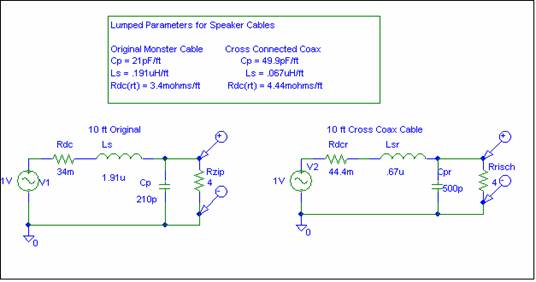
Frequency Vs Attenuation Characteristics of 10ft 12AWG Zip Cord and Cross Coax Cables
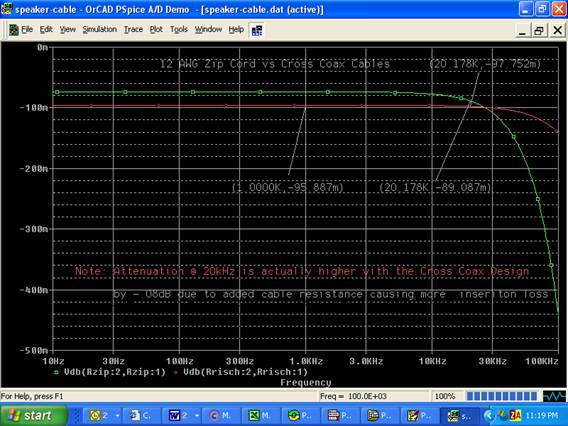
Note: Skin Effect loses (Rac) were not accounted for either of these cables for simplicity purposes and also because they would generally represent only very minimal losses ( < .05dB @20kHz) within the audio band and thus DC Resistance (Rdc) in this analysis is the dominant metric of comparison for resistive losses in speaker cables at audio frequencies.
For more information about Skin Effect and its relevance in speaker cables, click here.
|
Cable Length |
Corrected Analysis (Ls = .191uH/ft) |
Jon Risch Cross Coax (Ls = .067uH/ft) |
||
|
|
Insertion Loss (dB) |
20kHz total loss (dB) |
Insertion Loss (dB) |
20kHz Total Loss (dB) |
|
10ft |
-.07 |
-.09 |
-.095 |
-.10 |
|
50ft |
-.36 |
-.70 |
-.47 |
-.511 |
Analysis Review
12AWG Zip Cord
Insertion loss within the audio band is about -0.07dB while attenuation at 20kHz is only -0.09dB into a 4ohm load, Not -0.25dB as Jon Risch suggested. Note, if we use Ls = 0.25uH/ft for 12AWG Zip Cord as Jon suggested, it would yield -0.10dB attenuation at 20kHz which is still much less attenuation than Jon Risch claimed. As we approach longer lengths, we see more high frequency roll off primarily due to increased cable inductance.
The insertion loss of a 50ft 12AWG cable is about -0.36dB throughout the entire audio band until rolloff begins about 10kHz resulting in a total loss of -0.70dB @ 20kHz into a 4ohm load, again much less than 1.3dB that Jon Risch claimed. Even if we assumed that Ls = .25uH/ft as Jon Risch suggested, the loss at 20kHz into a 4ohm load would still only be -0.90dB NOT 1.3dB.
Coax Cable
Unfortunately due to the added DC resistance inherent in this cable design, we see uniform insertion loss throughout the audio band of about -0.10dB into a 4ohm load. Note this loss is throughout the entire audio band and represents a greater loss than 12AWG Zip Cord at 20kHz of the same length! This insertion loss will only get worse as cable length increases, or speaker load dips lower due to the more prominent voltage divider relationship between the increased DC cable resistance and the low impedance speaker load. Thus the benefit of reduced inductance of this cable design is greatly compromised by the additional uniform insertion loss within the entire audio band do to added DC resistance.
As cable length approachs 50ft, we see insertion loss ramp up to -0.47dB until we reach about 20kHz where we see a total loss of -.511dB into a 4 ohm load which is certainly higher than the -0.35dB that Jon Risch claimed, and not much lower than ordinary 12AWG zip cord (0.70 - .51 = 0.19dB) difference, or in the extreme case of a poorly designed 12AWG Zip Cord with maximum inductance claimed by Jon Risch (0.90-0.511 = 0.39dB).
It is doubtful that any audible differences between these cables would be perceived based on the attenuation characteristic differences, especially at 20kHz where the human ear is least sensitive and music is only harmonic in nature with little or no energy.
Wrapping It Up
Based on this analysis, it is clear that the Coax Cable design does have wider bandwidth than the 12AWG Zip Cord. However, at audio frequencies this mostly irrelevant since both designs are responsible for less than -0.10dB loss in the 20 kHz audio bandwidth for cable lengths of 10ft in high end systems. Yet the Coax Cable design, because of its increased DC resistance, resulted in a -0.1dB loss within the entire audio bandwidth, which would be even more apparent as cable length increases or speaker load impedance decreases. The added capacitance of the Cross Coax cable design can also represent stability problems as cable lengths increase, especially for esoteric tube amp designs with higher output impedance and lower unity gain crossing. It is possible for high capacitive loads of a cable to cause two related effects due to loss of the power amp gain and phase margin. Firstly, in the frequency domain, very significant gain peaking can occur. Secondly, in the time domain, the step response may have a much higher overshoot, and exhibit excessive ringing (at about the unity gain frequency) due to loss of power amp phase margin from excessive capacitive loading.
In defense of the Cross Coax cable design, 49.9pf/ft is about 5-10 times lower than some of the "exotic" cables we have measured, thus it would probably take quite a long cable run with a not so ideally designer power amp to present a significant problem with amplifier stability. On a less serious note, some people may prefer the excessive frequency peaking due to overshoot that high capacitance speaker cables may cause, assuming rampant oscillations are not present, as the listener may possibly perceive it as sounding "brighter". The question should be asked however, "Do you want your cables to act as tone controls, or be as transparent (accurate) as possible?"
A Note About Zobel Networks
Jon Risch's solution to stabilize oscillating amplifiers presented with high capacitive cable loads is to install a Zobel network (Shunt resistor and series capacitor). While this may help stabilize a highly inductive load resulting from the cable/speaker combo by making it look more resistive, it may not always resolve amplifier oscillations resulting from too much capacitive loading, and can sometimes have its own inherent problems, especially if the amplifier itself is already compensated for. Zobel networks should usually be applied (if needed) as close to the source as possible, and not necessarily at the speaker. The speaker, if designed properly, usually has already been compensated for in some capacity. By adding the Zobel network at the speaker like Jon Risch suggested, you can actually increase shunt capacitance (if you choose an improper R & C value) that the amplifier sees and possibly further increase the likelihood of amplifier instability or overshoot. A Zobel network at the speaker end of a cable is (usually) next to useless. While it can provide a termination at very high frequencies, (which the speakers sometimes cannot because of their own inductance), by that time the damage is usually done, and the amplifier is happily oscillating. It is common with many amps to use a series inductor (usually in the vicinity of 0.8uH or so) to isolate the amp from external capacitance, but this rather negates the "requirement" for ultra-low inductance cable. Alternatively a series resistance at the output of the amplifier may dramatically help to reduce risks of amplifier oscillation due to capacitive loading, but at the extreme trade off increasing insertion loss and sometimes of maintaining a decent damping factor (Ratio = R(speaker+cable) / Rout(amp)) if the resistor value becomes large enough.
As we can see in the above analysis, there maybe no real apparent benefits to the Cross Coax cable design over ordinary 12AWG Zip Cord for high end audio speaker cable applications. If inductance is truly a concern, then one could certainly choose a closely spaced twisted pair variant of 10AWG or 12AWG Zip Cord, which will maintain low DC Resistance, critical for accurate and high performance realization. When you consider the potential negatives of Cross Coax cable designs (IE. Increased DC resistance, excessive capacitive loading), and the hassles (IE. attempting to compensate for stability issues with Zobel networks, series inductance and/or resistance), determine for yourself if it's really worth pursuing this effort, and if you have the time, patience and know how to proceed?
Final Thoughts
Is 10AWG or 12AWG Zip Cord the epitome of high end cable design? Probably NOT. But it certainly should be the minimal guideline cable designers use to judge their "exotic" cables against. The sad reality is, so many of the so called "exotic" cables out there actually achieve less accurate performance than ordinary 12AWG Zip Cord, yet many cable vendors manage to sell it off to consumers at prices between 2 to 10 times more!
We fully encourage audiophiles or hobbyists that wish to experiment with "exotic" cables to first try a design such as this Cross Connect Coax or a Cat 5 variant. Although many of them are higher in capacitance than standard Zip Cord, and sometimes higher in DC resistance, they are an excellent way to "try before you buy", and Jon Risch's recipes are reasonably good and cost effective to produce, even if his claims of their performance are a bit overstated. While there are inherent risks, as previously mentioned in this article, with some DIY Cross Connect Coax and/or other "Exotic" cable variants, they can at times alter the sound of a system to a listeners liking. Our goal at Audioholics.com is to objectively measure and quantify cable performance based on accuracy and transparency, not to determine or dictate what sounds best to the listener. We leave that up to you to make that decision for yourself.
We have just finished acquiring cable samples from various vendors and will be measuring their cable metrics using the WAYNE KERR Precision Magnetics Analyzer and an HP Network Analyzer to determine their accuracy while also verifying their claims. We will report on this shortly. Stay tuned..
See our Results from Speaker Cable Face Off I
Original Publish Date: 4/24/03
Updated 4/29/03 - added comment about mutual inductance of Cross Coax reducing inductance of Cross Coax cable design as per Jon Risch's feedback.
Updated 4/29/03 - corrected Ls for 12AWG Zip Cord calculations by adding self inductance term. Redid 12AWG Ls measurements with longer cable to eliminate errors due to short leads and termination.
Last Updated: 06/01/03
Gene manages this organization, establishes relations with manufacturers and keeps Audioholics a well oiled machine. His goal is to educate about home theater and develop more standards in the industry to eliminate consumer confusion clouded by industry snake oil.
View full profile Subscribe to our newsletter