


AV Receiver and Amplifier Power Ratings Trends: Manipulating Wattage Ratings
How and Why Wattage Ratings are Manipulated
Originally published: Nov 9th, 2004 by Patrick Hart
Stereo reproduction in the fifties morphed from separates built by small high-end manufacturers like Saul Marantz to entrepreneurs like Sidney Harman who is credited with marketing the first receiver. Throughout the early sixties Harman-Kardon was joined by other American companies like H.H. Scott, Lafayette and Fisher until, toward the end of the decade, the Japanese joined the receiver category with lower cost receivers touting "innovations" like my (first receiver) JVC with a 5-band equalizer built-in.
At the time I had been used to a Marantz Model 7C pre-amp and Model 15 amp so the JVC, in comparison, sounded like absolute dreck. But there was no denying that the receiver configuration brought prices and quality music playback down to price points affordable to many more consumers.
In the seventies, the second wave of better-built, better-sounding receivers came first from the likes of Superscope who had bought the Marantz name from Saul Marantz in 1968. The Marantz 2230 (30 watts x 2), 2245 (45 watts x 2) and 2270 (70watts x 2) where sold in huge quantities and were carried in the line for six years! (Even after these models had been superceded by newer models!) This receiver line was absolutely dominant through the mid seventies quantity-wise. Though, little known to consumers, successive iterations of the exact same model had fewer and fewer parts. The result was, at the end of these three models' six year run, that their sound quality compared to the original production was severely compromised.
We've noticed a recent trend with the latest Dolby Atmos/DTS:X AV Receiver releases. Instead of publishing unclipped full bandwidth power with two-channels driven into 8 ohm loads per FTC mandate, ALL of the major AV receiver manufacturers are now touting power with only one-channel driven, at 1kHz, into a 6 ohm load and 10% distortion. This type of testing scenario inflates the power rating up to 2X the former FTC way of rating power. Only when you search for the fine print on the manufacturers websites or spec sheets do you actually find the two-channel continuous ratings. We decided it was time to republish this article and also supplement it with the following YouTube video citing examples of these latest AV receivers.
The Good Ole Days
The 1970's to 1990's
The Marantz 2270 (70wpc x 2)
The success of Marantz' Japanese-produced receivers emboldened companies like Yamaha, Denon and Onkyo to enter the US receiver market.. These manufacturers naturally targeted the high-end audio specialist retailers to sell their receiver lines. These retailers were the same guys who had started out, many as hobbyists themselves, selling separates in the fifties and early sixties. It was at this point, in the mid seventies that 100 watt x 2 receivers where first introduced. (So was quadraphonic 4-channel, but that debacle only caused the refocusing of the most desirable stereo receivers to be the 100-watt top-of-the-line models.)
The eighties saw the expansion of the market further with the introduction of the compact disc (1983). By this time the stereo receiver category had matured toward specific price points. Usually, five or six models, ranging from around $300 to $1200, were offered by the well known mid hi-fi brands like the big three of Yamaha, Denon and Onkyo. The step-ups within these price categories were always power and added features. Other than a "best seller" at a price point below $500 the next most sought after receiver was usually the manufacturer who could hit the magic 100 watts per channel at less than $1000 retail.
In the alternative tier of dealer distribution were the other brands who because they sold in far less quantities than the big three, might have slightly different product line-ups with slightly differing emphasis on power ratings and features. These included Harman-Kardon, Rotel, NAD, Marantz and a couple of others.
A most important "product positioning" fact needs to be taken into consideration at this time. Almost all competitors in the mid-fi categories also offered integrated amplifiers and separates which were the step-up configuration of choice if your were looking for "better" sound, higher power or more perceived value. Remember also that the receiver was an American (and partially Canadian) phenomenon. The Japanese home market and the European market had no receivers, as receivers were considered less desirable, lower-fi, by the rest of the world.
![[yamcr2020]](../../../images/yamcr2020.jpg)
The Yamaha CR-2020
In 1986 Yamaha introduced the DSP-1 Digital Soundfield Processor which just happened to have the original 3-channel Dolby Surround on-board. This Stereo Review Product of the Year was showcased in the (first) Yamaha Home Theater at the 1987 Consumer Electronics Show and caused a sensation which shifted the gears for an entire industry for many years to come.
The stereo-only receiver gave way to surround receivers and continued to gain momentum as better surround technologies like Dolby Pro-Logic took hold. Other receiver manufacturers were quick to add their own versions of enhanced listening environments like Jazz Club and Stadium, all of which required more than the traditional two left and right front channels to reproduce.
The "race", as it were, was on. But without guidance from any quarter as to what exactly constituted good or even adequate surround the question of how much power to allocate to how many surround channels was left up to the product management and bean counters of the individual companies. All that was available was Dolby's recommendation that the surround speaker have a low end frequency response down to 100Hz with its high end frequency response rolled off after 7kHz. To most designers at the time this said that we were free to put any cheap little 4" full range speaker in a box and it would meet the surround requirement.
The 100 watts per channel ideal was still found in at least the top-of-the-line receivers of this time. Even though the surround and center channel power ratings were lower as the engineers did whatever they could to still hit long established (stereo receiver) price points with multi-channel products.
I Still Want My 100 Watts!
The design-to-a-specific-cost criteria that was cast in stone in the early seventies, remained through the eighties, into the nineties and is carried on today. What happened in the early eighties is that Japanese manufacturers found it was not profitable to continue designing receivers in multiple sizes for the military, European, Canadian and American markets. Too much money was going into the cosmetics, faceplates and chassis of receivers which weren't stackable with other components. So in ~1982, just as the CD was coming to market, mostly all Japanese manufacturers picked 2 sizes for components; 350mm "midi" size and 430-435mm "standard" size. This set the width for a generation of products and helped to stabilize the stackability issue plus the faceplate and chassis cost at the same time.
For a receiver with an analog amplifier the highest percentage cost is for the transformer and filter caps which make up the power supply. Add to this the cost of the chassis, the packaging, a couple hundred other electronic parts, faceplates and knobs, lighting displays, owners manuals and the requisite remote control and you've got yourself a fairly narrow range of options from which to work at any given price point.
Through the late eighties and into the early nineties, receivers always had at least the left and right stereo channels touting the most power. One hundred watts seemed to have been the magic number back in the stereo-only era and that 100 watt RMS per channel figure held its cache in the transitional receivers of this period. Whatever price-point receiver had the magic 100 watts per channel was, if not the biggest seller in a manufacturer's line, then the most sought after.
Just prior to Dolby Digital it had become "uncool" to have less power for the center channel since it was promoted as being vital for movie dialog. So the new paradigm became 100 watts x 3 for left, center and right front speakers. But it was still okay to have less power and lower quality speakers for the surround channels because the Dolby Pro Logic then available was used mainly to produce ambient sounds like crowd noise and rain.
AV Receiver and Amplifier Power Ratings and Trends - Page 2
100 Watts in Every Channel
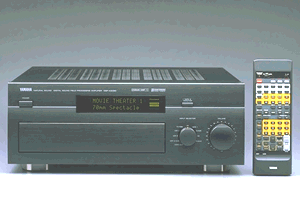
We're in the late nineties now and Dolby Digital, AC-3 as it was known back then, becomes available. The configuration is 5.1 and it is "recommended" that all channels in receivers be of the same power. THX recommends the same equal power for all channels so for the first time since the mid-eighties there is actually some direction given to receiver manufacturers. And as usual, the burden went back to the product managers and engineers who now were faced with producing 5-channel (at the minimum) receivers with wattages and at price points that ten years earlier had been stereo-only product. AC-3 changed the receiver category which saw for the first time examples of "statement" integrated amplifiers like the Yamaha DSP-A3090 which retailed for $2500(!) in 1996.
Why back to the integrated amp configuration? Quantities . Even at $2500 the all-channels-equally-powered A3090 was seen as somewhat of less than a fully acceptable statement piece in America because it had "only" 80 watts per channel x 5.
The Yamaha DSP A-3090
Europe and Japan had also embraced 5.1 surround and to these buyers with generally smaller living spaces the 80 watts per channel was quite acceptable. So the DSP-A3090 went on to sell in the thousands while paving the way for equal high power receivers at the lower and more traditional price points.
Yamaha DSP A-3090
Present Day
100 Watts Still Rules!
Now, jump forward to the current paradigm asked of the leading mid-fi receiver manufacturers. That all receivers, no matter how inexpensive (for the larger Japanese manufacturers), must be rated at 100 watts/channel. How is this possible?
One answer to this seemingly incongruous specification is that some 100 watt amplifiers are more capable than others when taking on lower impedance speaker systems. But amplifiers are never rated when driving speaker systems, they're rated when driving fixed-load 8 ohm or 6 ohm resistors (which can be a much easier load to drive from an overheating standpoint than a 4 ohm load). This fact gives the manufacturers a little wiggle room with their power spec and the amount of costly heat sinking they must use to obtain agency approvals.
This "wiggle room" is more real than you might expect because many loudspeaker manufacturers' supposed 8 ohm impedance loudspeakers are closer to a 6 ohm rating than being a true eight ohms. The loudspeaker guys design this way, using woofers with a 5.5 ohm DCR (direct current resistance) so that their loudspeaker will play louder than their competitor's 8 ohm speaker. Louder is always better on the sales floor.
The 6 ohm minimum rating that has so many consumers concerned when they see it on the back of their just-purchased receiver is also a nod to testing agencies such as UL that cost cutting had to take place with a 100 watt $300 or $500 receiver. There are a couple of facets to this argument:
- Do you want a true "100 watt" receiver for $299? If the answer is yes then you need to understand the conditions under which you can achieve 100 watts. (There are always conditions.)
- A given for large manufacturers (in the US anyway) is that all products must pass the costly UL testing to be considered safe (and exempt manufacturers from lawsuits) under most normal operating conditions. It turns out that engineers have found that one of the best "sweet spot" cost cutting measures with 5.1, 6.1 or 7.1 receivers is to not offer second pair switching capability and to design the power supply section for 100 watts at 6-ohms. This is less costly than having to design for a 4 ohm load speaker which takes lots more current or an 8 ohm speaker which requires higher voltage rails from the "just enough" power supply/power amp combination.
- For consistency's sake, manufacturers like to quote distortion figures as an important feature. So, for instance, the bottom four receivers in a line may have 0.06% THD and the top two receivers may have 0.04%. This number is really nothing more than "graph manipulation" (explained below). Of note though is that in the "old days" of stereo receivers the engineers didn't have to deal so much with pinching pennies in the power supply to achieve THD figures that were one third of what they are now. As quantities of receivers sold have increased so have has the competition in shooting for that illusive 100 watts/channel figure. But larger quantities buy lower parts prices. (Think less $ for the same VA rated transformer.)
A second, also fairly well understood way to be able to quote "more power" is by quoting the power at only 1kHz instead of the more traditional 20Hz to 20kHz figure. In some cases the difference can be 15% to 25% more power at 1kHz. This type of rating is sometimes seen with a manufacturer who has two separate levels of distribution with separate model numbers for each level, though the actual receiver itself may be essentially identical.
For instance, one level of distribution might be mass market outlets where it is assumed that the typical customer is less sophisticated and will thus look only at the single (and highest) power rating as an indication of a receiver being "better than" a lowered powered competitor. The other level of distribution is with the audio specialist retailer who has been with the manufacturer for sometimes decades. It is the audio specialist who will have the "signature" line of model numbers, so to speak, all with power outputs rated from 20Hz to 20kHz and a distortion figure which is usually ( but not always ) carried throughout the line.
100 Watts by Curve Reading
The last and least understood area wherein the manufacturer can retain their 100 watt rating across the line can be understood if you learn how to put a few seemingly disparate specifications and a power vs. distortion graph together. I'll stick with Yamaha as my prime example since they are known as one of the dominant players in the mid-fi category, (at least in the enormous quantities they sell through their various distribution channels).
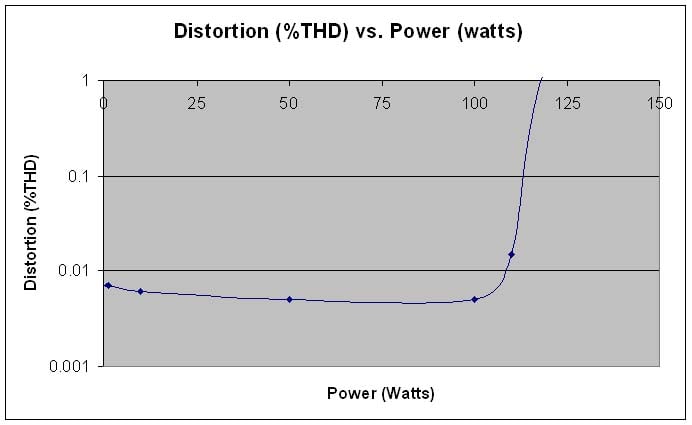
Here's an example of your ubiquitous 100 watts RMS/channel output power vs. distortion curve which you seldom see published anymore:
Distortion (THD) vs Power (Watts)
Your "conservative rating" manufacturers like Harman-Kardon, for instance, will quote only power ratings for their receivers which always stay about 20% under the area in which the curve is fairly horizontal. In this case HK might rate this as an 80 watt RMS/channel receiver. Power for HK (and to an extent Rotel, NAD and Marantz) are rated in this "old fashioned" manner. This is part of these company's "better performance" marketing strategies and it is an entirely legitimate one.
Understanding Power Ratings in AV Receivers YouTube Video Discussion
AV Receiver and Amplifier Power Ratings and Trends - Page 3
The New 100 Watt Solutions
The numbers game comes into play with the mid-fi receiver manufacturers who hold larger receiver market shares via higher sales quantities of each model in their lines. Bear in mind that we've now gone through over 40 years of receiver design configurations. And from stereo receivers to 5 and 7 channel receivers and yet the price points throughout manufacturer's bread-and-butter models have remained almost constant. This is miraculous and a tribute to the designers and engineers and the companies who have striven to give their customers the best bang for the buck.
Barring testing major quantities of each model in each manufacturer's receiver line-up, I long ago (as Yamaha's Product Manager) learned to put a couple of specifications together to figure out how many "platforms" a particular receiver line from a major Japanese manufacturer might be using. I'll use Yamaha as an example once again because their receiver line-up seems to indicate the same two-platform line is carried on today as back in the eighties but with the added wrinkle that the lowest priced receiver is most probably built outside of Japan for cost reasons.
Look for differing chassis sizes . In the case of Yamaha there are three different chassis sizes.
In the chart below are the first two. Note that the RX-V450 has a slightly different chassis size than the other three more expensive models. This would indicate to me that this model is probably made under contract in China and that that manufacturer may have had a chassis already on hand or that that particular size may have allowed the contract manufacturer to build Yamaha's receiver for a bit lower labor cost. Whatever the reason, because a particular unit is built by another company does not mean it is any way of less quality than the rest of the Yamaha receivers. Rest assured that Yamaha probably has a full-time, well trained factory crew watching this and other contract factories on an almost daily basis to maintain the quality level necessary to carry the Yamaha name.
|
MODELS |
RX-V750 |
RX-V650 |
RX-V550 |
RX-V450 |
|
MSRP |
$649.95 |
$549.95 |
$449.95 |
$299.95 |
|
AMPLIFIER SECTION |
|
|
|
|
|
POWER RATING 1kHz @ 8 OHMS |
7 X 115 WATTS |
7 X 110 WATTS |
6 X 10⁵ WATTS |
6 X 100 WATTS |
|
POWER RATING - 20Hz - 20kHz @ 8 OHMS |
7 X 100 WATTS |
7 X 95 WATTS |
6 X 90 WATTS |
6 X 85 WATTS |
|
THD (%) @ 8 OHMS |
0.06% |
0.06% |
0.06% |
0.06% |
|
LINEAR DAMPING FACTOR (20-20kHz) |
140 OR MORE |
140 OR MORE |
100 OR MORE |
100 OR MORE |
| Height |
6-3/4" | 6-3/4" | 6-3/4" | 6-5/16" |
| Depth |
16-9/16" | 16-9/16" | 16-9/16" | 16-3/8" |
| Weight (lbs) |
27.8lbs | 27.8lbs | 24.2 lbs |
24.2 lbs |
Okay, the other differences? Well the 450 and 550 are 6 channel receivers instead of 7 channel. So there's an easily discernible difference. And if you look at all the power figures @ 1kHz, 8 ohms you'll see that every receiver makes the magical 100 watt figure! Yes! That was the goal, most probably requested by the American sales and marketing team.
What is admirable on Yamaha's part though is that they still give full 20Hz to 20kHz bandwidth ratings at 8 ohms and a specific (maximum) THD figure for all models. These are the true wattage figures of which each individual power supply/amp section is capable before the "knee" of that power curve starts heading up.
Going back again; the 550 has 5 more watts than the 450 so what's the deal? Well, the units probably are made in different factories so the parts may be slightly different though rated identically. Similarly, the power supply is probably spec'ed identically but the 550's amp section may have the voltage rails bumped up just a tad to get that extra five watts. And that's the secret. Not much of a secret, huh?
Another item to look at is the weight of the 550 and 450. No difference. You're probably looking at identical power supplies and identical power amps, just different actual parts from different suppliers in different countries. And once again possibly, just possibly the 550's voltage rails are a volt or two higher than the 450 to claim the extra 5 watts.
Going up in the line to the RX-V750 and RX-V650 you've got an even more similar story. With identical weights you can be pretty certain that you've got identical power supplies with just the voltage rails bumped to make a couple more watts of power. Now onto the last way that 100 watts is still legitimately quoted…
That last and final way a couple of extra watts can be claimed for a receiver which has an identical power supply and power amp section is to simply quote power based on the higher distortion level of the curve after the knee as it heads up quickly toward the 1% level. By reading power figures off the curve after it's passed its lower distortion turning point or knee it's always possible to legitimately squeeze a couple extra watts out of a specification to keep the sales and marketing people happy. Just bear in mind that if you want to compare real watts vs. distortion you're always getting more accurate, real world figures on the horizontal section of the curve.
Remember too that it's extremely difficult to hear the difference between 100 watts and 110 watts. Like I said before, the 80-watt, 1996 Yamaha DSP-A3090 was one of the best sounding units Yamaha had built in years. And I believe part of the reason is that the engineers weren't forced to hit what was an unrealistic 100 watt figure given the great sounding, easy clipping, 80-watt topology they had at the time. The only other true avenue of freedom most receiver engineers have nowadays can be found in their top-of-the-line $4000+ receiver offerings. These modern day statement pieces are the closest the engineers have ever come to starting out with the proverbial "clean sheet of paper".
 Subscribe to our newsletter