


Attack of the Clone Amplifiers
Clone Amplifiers
It’s been a few years since we released Episode Attack of the Clone Processors, so I thought it was about time for a sequel. To my surprise, cloning is more popular than ever. The Cloning fad has apparently made its way into many of the amplifiers that use the highly respected Bang & Olufsen’s ICE modules, those being the focal point of this perversion. Is perversion too strong a word? Maybe not, when you consider the top end ICE Module 1000ASP has a wholesale cost for under $250 (according to several industry sources) per module (including the power supply). If we assume for the moment that the fixed cost of the 1000ASP ICE module is $250.00, and the average chassis cost for a manufacturer is $50.00 plus another $20 for connectors and wiring. Add another $50 to $100 to factor in labor and overhead and this brings us to a landed cost of around $370 to $420. It’s typical for any sophisticated and complex product, like quality electronics, to have an MSRP about four to five times the “landed” cost of the item. Multiply $370 by a factor of four for what we’ll call “industry-vertical profit” and it brings us to around $1,480. Perversion seems like an appropriate term to me when some manufacturers have the audacity to charge in excess of $4k for a repackaged version of this amplifier. This is especially true when you consider that very little can be done to this design to augment its performance or make it different other than cosmetically from its peers.
An Icy Perspective
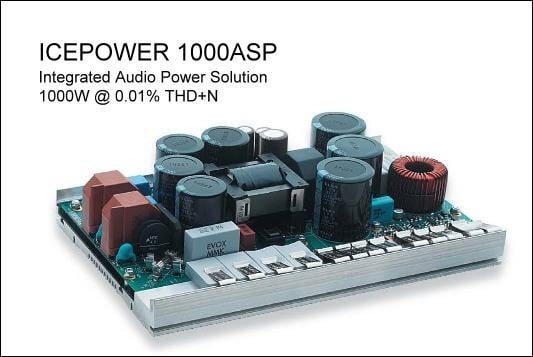 Let me step back for a moment and first praise Bang & Olufsen for designing and wonderfully executing a very good sounding Class D amp that is inexpensive, reliable and virtually bulletproof. The only criticisms I have are that these amplifiers cannot deliver anywhere near their rated power at full bandwidth continuously (or even for a 1 second duration) due to limitations in the design including the zobel network, output filter coils and power supply (see page 14 of the linked ICE Module data sheet). They also don’t exhibit linear phase response out to 20kHz. As a true audiophile who expects the very best performance from his amplifiers, I don’t believe it’s too much to ask that an amplifier that deliver its rated power at full bandwidth - especially at these prices. The alternative is to call it a true 150wpc amplifier (according to its FTC rating on page 6 of the data sheet) with 16dB of dynamic headroom. This way we’ll be able to compare apples-to-apples for all amplifier types when evaluating power claims. This is unlikely to happen because non-technical customers won’t be able to appreciate what 16dB of headroom really means. Most people want a single metric that is easy to understand, even if it is misleading. The retail sales force isn’t any help when it comes to educating the customer either. We expect linear amplifiers to deliver full power bandwidth continuously, so why play favors for Class D, particularly ICE designs? In most cases this doesn’t pose a practical problem since we don’t listen to continuous test tones. For all practical purposes, these amplifiers can deliver gobs of power at low frequencies where it’s needed most.
Why Consider Class D Amplifiers?
For one they typically run much cooler than conventional linear A/B designs due to their higher efficiency resulting from their fast switching speeds. This in turn reduces amplifier weight and footprint since you no longer need heavy and bulky heat sinks to dissipate the heat. The ICE module for example is very space efficient design thanks to its class D topology and SMPS power supply. It’s a durable amplifier that offers great space savings and good fidelity at a modest cost, well until it’s repackaged by esoteric audio companies for large profit margins.
Along with the positive attributes with any engineered system, there are always trade offs as well. Some audiophiles claim the ICE modules in particular aren’t as musically transparent as the very best linear designs. This may be a result of the power limiting or lack of phase linearity at high frequencies. What ever the case may be, there is a loyal following of enthusiasts whom claim to have found sonic nirvana in ICE. More power to them! In the end, everyone hears differently regardless of what the published specs say.
Editorial Note on Ice Design from a Speaker Designers Point of View
One of the primary items of note for a speaker system is the power handling figure. Those of us who measure speaker power handling can tell you that most speaker systems are capable of withstanding short term wide-band bursts of power which are far higher than a speakers continuous power handling capacity. Music is not continuous in nature, but has frequent peaks of power which are far above the overall running average of the song. This ratio of peak power to average power is known as crest factor. The standard crest factor of a continuous tone is only 3dB (a 2 to 1 power ratio). The standard crest factor in power test signals is 6 dB (a 4 to 1 power ratio). The crest factor of music can be 20 dB (100 to 1 power factor) or even more depending on the program material. So how does one find an amplifier which is able to produce the peaks which make music dynamic without getting an amplifier that is so powerful it destroys the loudspeaker when pushed too hard? Ice Power amplifiers make use of technology to offer this solution. That is to say their available peak is far more than the available average power. This makes the amplifiers safer for speakers, but difficult to compare to more conventional designs because of its very nature. How does one classify an amplifier; by its apparent average or Peak power? Each method has reason and science behind it. It is a lesson that one measure without the other, is not sufficient to give the observer enough information to come to any conclusion about how the amplifier will sound with music, the most important specification of all. Some would claim the most important specification of all is actually price per watt. If a 1000 Watt Peak amplifier is more expensive than a 1000 watt continuous rated full power bandwidth one power amplifier, is the design a success? Likely it is not.Paul Apollonio
When you consider ICE amplifiers were specifically designed for subwoofer applications, and only later integrated audio systems, the design trade-offs B&O chose were clearly understandable. Things have changed since B&O stepped up to the plate by licensing these “cookie cutter” designs for OEM purposes. By “cookie cutter” I mean that the entire design, from soup to nuts, is done by B&O and sold to the licensing manufacturer for inclusion in a branded product. Quite literally, anyone with the licensing fee can take B&O’s amplifier module, slap it in a project box, add connectors and voila, they’ve got a full bandwidth audio amplifier. This is how the loudspeaker business has been operating for years, so maybe it was only a matter of time before amplifier manufacturers followed suit. It’s a common practice in the OEM business and makes economic sense for small companies that don’t have the resources to do their own developmental work.
Let the Clone Wars Begin
Doing a quick Google search of ICE amplifiers, we found the following manufacturers selling the same 1000ASP ICE module in their own form factor as mono block designs.
- Rotel RB-1091 - $1,500 per channel
- Seymour AV Iceblock 1001 - $1,399 per channel
- Wyred4Sound SX1000 - $1,199 per channel
- Bel Canto Ref 1000 mkii - $2,995 per channel
- Jeff Rowland Model 501 -$ 4,700 per channel
Of course there are other manufacturers such as D-Sonic, PS Audio, etc offering variants of this module either as multi-channel amplifiers or as the lower end ICE modules. Tabulated below are a few brands and models of similar design which use the 1000ASP 1000 watt ICE module. This is by no means a comprehensive list of all manufacturers productizing ICE, but it illustrates a general example.
Comparison of Specs
| Manufacturer | Rotel | Bel Canto | Seymour A/V | Jeff Rowland | Wyred4Sound |
| Model # | RB-1091 | Ref 1000 mkii | Ice Block 10001 | 501 | SX1000 |
| Rated Power, Channels | 1000w x 1 | 1000w x 1 | 1000w x 1 | 1000w x 1 | 1000w x 1 |
| Max Output Power 0.1% THD+N, 1kHz (AES17 filter) |
>1000W 4 ohms >500W 8 ohms | >1000W 4 ohms >500W into 8 ohms | 1100w (4.0ohm) 600w (8.0ohm) |
1000w (4 ohm) 500w (8 ohm) | >1140W 4 ohms >570W 8 ohms |
| Max Current Output | 40A | 40A | 40A | > 45A | 40A |
| Dynamic Range / SNR | 118dB | 120dB | 119dBA | 120 dB | 118dB |
| THD+N f=1kHz, Po=1w, 4 ohm |
< .03% | 0.007% | 0.007% | Not specified | < .03% |
| Frequency Response | 10 to 40kHz +-3dB | +/-0.5dB 20Hz-20KHz, all loads | 5.3Hz-38kHz (8ohm) 5.3Hz-31kHz (4ohm) |
5 to 45kHz 3dB | 10 to 40kHz +-3dB |
| Output Idle Noise | Not specified | 90uVRMS A-weighted 10Hz-20KHz | 80µV | Not specified | 80 uV |
| Output Impedance f=1kHz |
Not specified | < 8 mohms | 5mhoms | Not specified | 5 mohm |
| Input Impedance | Not specified | 100k | Not specified | Not specified | 60k |
| Nominal Voltage Gain | 27.2 dB | 27.2dB | 26 or 32 dB | 27 dB | |
| Damping Factor | 400 | 2000 | 2000 | 1000 | 2000 |
| Minimum Load Impedance | 2 ohms | 2 ohm | 2 ohm | 2 ohm | 2 ohms |
| Intermodulation (CCIF) |
0.0007%, 1W, 14:15KHz, 4 ohms | 0.002% f=14kHz, 15kHz, Po=10w | .003% f = 19/20kHz | ||
| Idle Power | 34w | 15w | 15.8w | 15w | 15w |
| ICEpower Module | 1000ASP | 1000ASP | 1000ASP | 1000ASP | 1000ASP |
| Dimensions (in) (H x W x D) |
3 5/8 x 17 1/8 x 16 1/8" | 2 x 8.5 8.5x 12 | 3.2 x 8.5 x 15.1 | 2.85" x 8.4" x 13.0" | 4” x 8” x 13” |
| Weight | 17 lbs | 15lbs | 12.2 | 17lbs | 14 lbs |
| Price (USD), each | $1500 | $2995 | $1399 | $4700 | $1199 |
A Closer Look at the Specs
Despite the fact that these amplifiers are all virtually identical, the specs do seem to vary slightly. Upon closer inspection, the variances appear to be a result of vague ratings like not specifying bandwidth or distortion for power or not disclosing if the Dynamic Range was a nominal or max rating and how it was actually measured. For example according to the ICE data sheet, the 1000ASP will put out 1000 watts at .01% THD and 1175 watts at 1% THD at 1kHz into a 4 ohm load. That explains the power differences in the above table despite the manufacturers reluctance to offer full disclosure. In fact some of these amps rated THD at 1 watt while others rated THD at 10 watts. To go further, virtually all of the distortion measurements listed are at a single frequency, 1 kHz and may not be representative of how the amp performs at higher frequencies due to switching residuals.
An additional anomaly is the 4-ohm rating. Traditionally power amplifiers are “badged” based upon their output into an 8-ohm rating. If voltage is held steady and current is allowed to vary (a constant voltage source), then power will increase into lower impedances to the limit of the power supply. Is the 4-ohm reference selected in order to provide a more impressive statistic? It’s probably a valid technique if the intent is to measure deliverable power into a 4-ohm driver exclusive of a passive cross-over, but full range speakers are anything but that!
Have amplifiers become the next fashion design fad?
If you examine the ICE data sheet you will in fact notice that none of the manufacturers productizing this module actually conducted and published their own measurements. They instead chose what they wanted to publish from the actual ICE data sheets. All in all, it’s blatantly obvious we’ve got identical amplifiers specified differently on our hands but at such disparate price points with units ranging from $1199 to $4700. One could argue that you could buy a Casio watch for $50 or a Rolex for $5000 that both tell time with equal precision, but have we reached the point where amplifiers are now the next fashion design fad? Surely there must be other differences to justify the price variances? Well there are some minor differences, and please don’t call me Shirley. (Apologies to Leslie Nielsen!)
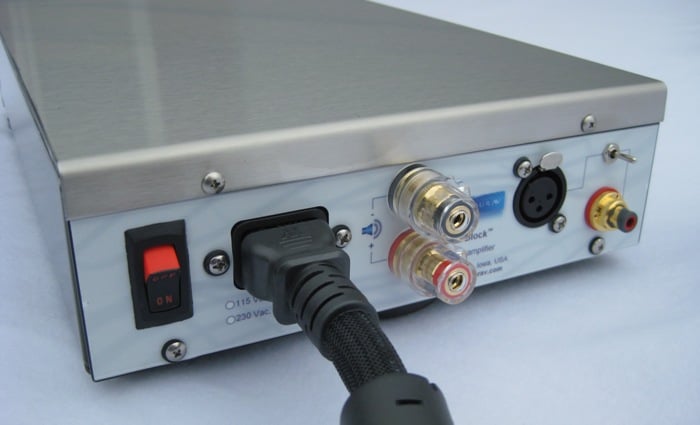
Each manufacturer boasts their exotic connectors are chosen for the utmost purity of signal. In a switching amp loaded with harmonic residuals it’s almost an oxymoron! Some go so far as to claim they add extra filtering components to enhance performance. I don’t doubt a few extra parts here or there have been added (likely input filters and chassis filters to reduce radiated and/or conducted noise). I do however question whether or not the $3500 per channel price jump from say the Seymour to the Rowland versions can really be justified, or if the manufacturer is simply just selling the consumer a nicer enclosure and a more prestigious name at a more illustrious price point.
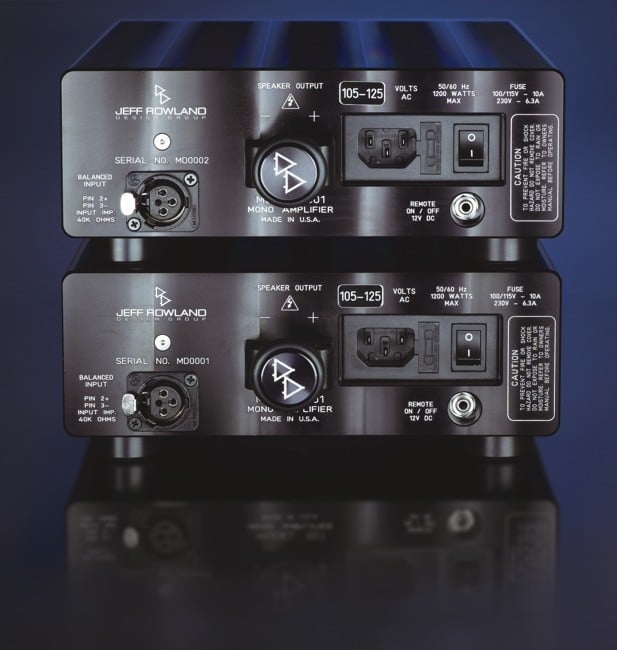
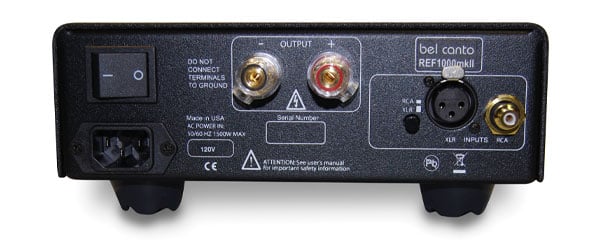
Rowland Model 501 Bel Canto Red 1000mkii
Wyred4Sound SX1000 Seymour A/V 10001
Anyway you slice it, we’re knee deep in a clone war with no hope for a cease fire anytime soon. Sure these cloners are clever. They move their connectors around, anodize their chassis in different colors and even slap a ferrite bead on the power cable in an attempt to be different. Others simply add an input resistor to increase the input impedance of the amplifier. In the case of Bel Canto, they claim that increasing the amp’s input impedance to 100K-ohm reduces noise, and makes it easier to drive, thus improving performance. While an ideal amplifier would have an infinite input impedance and zero output impedance, noise and distortion, this is not an ideal world. It’s the real world. Increasing the input impedance to too high a value only provides a better path for RF pickup from attached devices or nearby radiating sources. What the manufacturer may also fail to realize is that increasing input resistance will also increase thermal noise, also known as Johnson Noise. It may decrease current noise, but likely not enough to compensate for the increase in thermal noise, which is unavoidable with higher input impedances. Thus I see no benefit to increasing the input impedance from a nominal 20 K-ohm to 100K-ohm. It’s almost as if the manufacturer is expecting a esoteric pre-amp to drive it. Let’s be honest. Anyone spending $5k per channel on a mono block amplifier isn’t driving it with a preamp that can’t produce 2Vrms into a 20kohm load. I know $500 receivers that can meet this minimum requirement! Jeff Rowland takes it up a notch by giving you the most fancy speaker connectors I’ve seen, and a selectable gain of 26dB or 32dB, which I feel is useful - but not at a $4,700 price tag.
Seymour A/V, whom I originally thought was charging too much for their amplifiers until I realized they were giving you virtually the same product as the other more costly companies mentioned here, throws in some exotic internal cabling and Neutrik connectors as well as slapping a ferrite on the power cord. The ferrite is something I’d never recommend using on a power amp or any properly designed piece of audiophile gear but it’s different which is important when trying to distinguish your product among a sea of clones. Rotel is the only manufacturer that truly made their product appear different both in form factor and looks. They went with a chassis that could be rack mounted and take on the more traditional look of their linear amplifiers. They also kept the price reasonable unlike their more esoteric peers. Oddly their idle power is 2X higher than their competitors which I could only imagine is from the backlighting of the chassis. So much for being a green design.
I can count the number of manufacturers producing their very own Class D designs and still have a finger left to point at all the copycats.
One thing all of these manufacturers have in common other than selling you a near identical item, is their attempt to differentiate their product making their clones seem more humanistic. Wrap it with fancy marketing and exotic parts usage and you’ve got yourself an audiophile product that can be sold for whatever the audiophile is willing to shell out to their favorite manufacturer. ICE modules aren’t the only amplifiers being cloned. There seems to also be another less popular though more costly amplifier module from Hypex called UcD that is also being productized by some manufacturers and DIY folks. Pick your flavor, you’re preferred brand for repackaging, and decide with your wallet if those products are right for you.
Doesn’t Anyone Design Anymore?
 We live in a society that spoon feeds us manufactured news, fast food and prescription drugs anytime we sneeze. I can count the number of manufacturers producing their very own Class D designs (ie. Hypex, Axiom and B&O) and still have a finger left to point at all the copycats. The truth is most companies don’t want to spend the money and time for development of their own products these days. Engineering a product from the ground up, especially one as complex as a switching amp, takes time and money with the end result often not being as good or cost effective as what can be bought off the shelf like these ICE modules from B&O. This is especially true since anything new will likely be copied overseas as there is essentially no enforcement of intellectual property rights in Asia.
Overall this seems to be a good design approach for manufacturers unwilling or unable to do their own developmental work if cost and full disclosure of performance is kept in check. It’s up to you the consumer to determine if you desire to pay a premium price for exotic accessory parts and cosmetics. Just don’t let anyone tell you that regardless of price, you are buying anything other than a clone amplifier, albeit a reasonably well engineered one. Stay tuned for our final installment Revenge of the Clone XXXX coming to a home theater publication near you.
For an informative read about the potential limitations of Class D amplifiers, I suggest checking out:
Gene manages this organization, establishes relations with manufacturers and keeps Audioholics a well oiled machine. His goal is to educate about home theater and develop more standards in the industry to eliminate consumer confusion clouded by industry snake oil.
View full profile Subscribe to our newsletter