


Room Acoustics: Isolation & Noise Control
Taught by Steve Haas of SH! Acoustics
Our first three courses in the CEDIA Seminars series covered proper system calibration after installation and set-up was complete, followed by two complementary courses on room acoustics. More often than not, however, a great home theater must be capable of co-existing within the framework of the day-to-day goings on in the rest of the house and its occupants. This is where an understanding of how to isolate your home theater so as to control the inevitable noise leakage of dinosaur foot falls and anti-aircraft guns in the rest of your home's living space can be a really good idea.
Steve Haas' company, SH! Acoustics, www.shacoustics.com specializes in room isolation and noise control. In the best case, Steve and CEDIA-certified specialists like him should be called in during a home's initial design so that he can coordinate with the home's architect. Retrofitting of fully isolated home theaters is also possible, though sometimes much more time consuming if, for instance, existing wall structures need significant modification.
Most of the basic principles presented here can also be applied to dual-purpose rooms. It is possible to achieve moderately better overall dynamic range with attention to details such as suppression of A/C noise, plumbing and room- induced rattles. What will not usually be possible with dual-purpose rooms, however, is the attainment of the greater degree of isolation from the rest of the house, especially in the bass frequencies. It is this greater degree of isolation which can add ~20dB of dynamic range to a system. This is a huge expansion of dynamic system capability. And it cannot be achieved by any other (sane) approach.
The goal of room isolation is two-fold:
- Provide an environment free of extraneous noise and vibration intrusion (within the home theater).
- Prevent theater sound from interfering with other home activities or neighbors.
That first statement in bold above should be a goal of all home theater or music listening environments. We will talk about terms and measurements which can be used to describe the absence of extraneous noise in the pages following. The most important point to be made here though is that every 3db of extraneous noise eliminated in the listening environment results, in essence, in a 3dB gain in dynamic range. And properly executed, those 3 dB can add up quickly. Contrast these multiple 3dB gains with the single 3dB gain experienced from a doubling of amplifier power and the efficacy of proper room design becomes much more appealing. Let's define….
Dynamic Range
Basic Definition - The difference, in dB, between the loudest and the quietest sound in any audio program. For example, Compact Disc audio, with 16-bit encoding, has a theoretical dynamic range of 96dB. In order to be able to actually hear these loudest to softest extremes, however, all components in the playback chain need to have greater capabilities.
For instance, the signal-to-noise ratio of a receiver or pre-pro plus amplifier needs to be greater than 96dB. High quality amplification components most times have no problem meeting this spec, many having S/N ratios over 100dB. So let's proceed to the listening environment. For it is the listening environment which is always the biggest roadblock to extended dynamic range.
A typical audio track, whether music or movie, might have a dynamic range of 80dB (based on the content of the track). A non-isolated home theater with an ambient noise level of 45dB and a peak playback level of 105dB would result in an effective dynamic range of 60dB, or the masking of the lowest 20dB of dynamic audio information on the track. (Note also that 40dB is generally considered the ambient noise level in a quiet neighborhood.)
For reference, let's take a look at a standard, say what THX requires for a home theater to be certified. Their "quietness" spec for a home theater is less then or equal to NC22 (explained below). That's quiet! But the "room quietness" spec on the low end coupled with an 115dB peak requirement for subs and 108dB for satellites (both with no audible distortion) is what gives a THX certified theater its huge 86dB dynamic range (108 - 22 = 86).
Next, for a second standard with which to compare; Harman's Multichannel Listening Lab environment, which I often reference, has an NC of 5!! Thus, when double-blind listening tests are performed at their nominal 75dB level (B-weighted at 3 meters) the Listening Lab has a dynamic range of 70dB. Note that to get down to the NC 5 Noise Criteria figure the door leading into the Listening Lab is approximately one foot thick! And you have to step up eight inches or so onto the fully floating floor!
Room Acoustics: Isolation & Noise Control - page 2
Elements to consider when seeking to maximize the isolation and control the noise from your home theater are:
- Locating the theater - where, within the house, given the choice, would be the best location for the theater.
- Internal noise isolation - a dynamic range somewhere greater than 70dB would be a minimum figure.
- Impact/footfall Noise Isolation - footfalls heard inside a home theater from above means bass can escape out of the HT.
- Environmental Noise Isolation - A/C has to come into the theater and projector fan noise may require further isolation.
The terminology used describe the degree of isolation achieved outside the theater is quite different than that used for the in-the-theater room acoustics. In parts one through three of The CEDIA Seminars we were focused on damping reflections within the room in an attempt to realize a direct-sound, flat-frequency-response at the listening position. Here, in part four, we seek to achieve as quiet an environment as possible, which adds to the system's dynamic range, while at the same time confining that great sound, to the greatest extent possible, within the home theater. Some terms:
- Noise reduction (NR) - the measured difference in sound level produced in two enclosed spaces or rooms - a receiving room and a source room - by one or more sound sources in the source room.
- Transmission loss (TL) - the measured difference (usually in a laboratory) of the sound levels between the source and the receiving room taking into account the area of the common partition and the sound-absorbing characteristic of the receiving room.
- Noise Isolation Class (NIC) - the single number rating of a partition's isolation value based on field measurement of NR at one-third octave bands.
- Sound Transmission Class (STC) - the single number rating of a partition's isolation value based on laboratory measurement of TL at one-third octave bands.
Notes:
- The higher the NIC or STC number, the more overall isolation value a partition has.
- NIC and STC are not defined below 125Hz. Therefore, understand the limitations of their usefulness for home theater or other applications requiring low-frequency isolation.
One last term: Impact Insulation Class (IIC) - Said to be a measure of foot falls, the new method unofficially known as the "tire drop' is a single number rating of a partition's isolation value based on field measurement of NR at one-third octave bands. This "tire drop" test was developed in conjunction with the Acoustical Society of America and is the best test we now have to measure structure-borne transmission such as with subwoofers.
Note however, that this test can only be made after the entire home theater project is completed. So it is essential that a specialist in home theater isolation design be employed from the project's outset. Each small detail of an isolated room design must be perfectly executed and checked before the next step is attempted. There exists literally dozens of ways for a room's isolation to be "short circuited" by improper mating or termination of a floating part of the room assembly to a fixed part of the assembly. And such a mistake, however minor, can cause gains in a room's Noise Criteria (NC) when there should have been losses.
Locating the Theater - Basements
Home theaters, even in new house construction, are usually already assigned a particular location within the home. If a basement is available, the noise leakage to other rooms will be either airborne noise through the ceiling or possibly duct-borne noise through (or around) the air conditioning ducts.
Considerations for basement home theaters are:
- The extremely strong (high "Q") bass peaks which are usually set up with rigid cement block construction. Constructing a second semi-floating internal wall will usually alleviate strong bass modes to a great extent.
- Sound transmission can still find a path through the air conditioning/heating system. Proper attention needs to be paid to the size and routing of the ducts. Also, sound material (covered later) can be added to ducts. And finally, the air conditioning ducts must pass through properly sealed and isolated barrier walls.
- A floating floor as opposed to cement-with-padding-and-carpet is always more preferable in a high performance home theater. Tactile-feel sound waves, so strong that you can actually experience a realistic simulation of an onscreen event, is the "crème" at the top of a high performance home theater. One need only experience the Cuba Gooding Jr. at-the-guns scene (with two really powerful, flat response subwoofers!) from Pearl Harbor to know what I'm talking about.
- And no. Sorry… you can't just run down to Home Depot and find some "soft squishy stuff" and hope that will suffice for a floor isolator for c) above. You need an engineered isolator and proper installation to float a floor correctly.
Room Acoustics: Isolation & Noise Control - page 3
Locating the Theater - Above Grade
We're now dealing with four (or more) potential walls plus a ceiling and a floor. If you have any "wiggle room" at all as to what space gets the nod as your new home theater it's helpful to have a basic understanding of how sound travels from inside the home theater and out to other parts of the house.
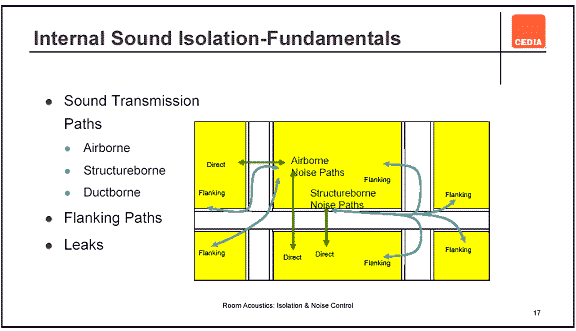
As can be seen in the slide, direct, through-the-air, sound paths are broken down into direct and "flanking" paths. Paths can be either airborne, structure-borne (low bass frequencies) and/or duct-borne. Leaks are also a problem and probably the most commonly overlooked mistake of do-it-yourselfer-type installations.
Effective use of buffer spaces around the theater can be quite beneficial. Buffer spaces include closets, storage rooms, hallways, lightly-used bathrooms, entry areas and living rooms in certain cases. Spaces to avoid locating adjacent to, above or below the theater would include; workshops, garages, bathrooms (heavy-use) bedrooms, exercise rooms, kitchens, dens/family rooms and children's play rooms.
Sound Isolation - Fundamentals
Once the location of the theater is fixed we can start figuring out which level of Noise Criteria (NC) or Room Criteria (RC), (a better number for low frequencies) we want to try to achieve. Increasing your system's dynamic range via internal sound isolation can be costly. A home theater, well isolated internally and also quiet externally, can easily add $25,000+ to the construction costs of a home. So it pays dividends up front to hire a professional who can apply a whole-room, systematic approach to designing each sub-system within and outside the theater.
Internal Sound Isolation - Walls
An isolated home theater can be thought of as four outside walls that are solidly affixed to the rest of the home structure with inside walls, floor and ceiling that are made to "float or hang" without ever being rigidly attached. Steve started out with some slides pointing out not-so-obvious fallacies that might get by a first-time home theater builder.
![[Slide30pitfalls]](../../../images/slide30pitfalls.gif)
![[Slide32walls]](../../../images/slide32walls.gif)
![[Slide36wallscomposite]](../../../images/slide36wallscomposite.gif/image)
The left slide illustrates the old theory of rigidity versus mass. A standard 2 x 4 wall construction with double layers of sheet rock on each side still does not have the equivalent actual sound deadening of cement cinder blocks, especially at the low frequencies, even though they are both rated at STC 50.
In the CEDIA class, Steve played an actual recording of music as heard outside of both types of wall construction, and the differences, especially in the low frequencies, were amazing. Again, this is because the STC ratings are not defined below 125Hz. Keep this fact in mind then as we illustrate other types of wall construction and dispel some myths about just how effective other forms of "miracle isolation products" really are.
Single-spaced studs vs. staggered studs. (See center illustration above.). There will be almost no difference in sound transmission. Perhaps just a little less bass.
Standard drywall vs. engineered drywall. Or mass barrier vs. constrained layer damping. Only a very slight difference in low bass (below 125Hz) attenuation will be noticed. And putting mass loaded vinyl between 2 layers of drywall is only as good as adding a third layer of drywall.
Resilient channels (RC1 channels). Can allow too much movement of sheet rock setting up a severe resonance at a specific frequency.
Inner walls themselves are usually floated on engineered isolator pads and secured to the solidly affixed outer walls by means of "sway bracing". Left slide,below.
Next, The intersection of walls with floors and ceilings/joists are more areas of potential sound leakage. Center slide, below.
Penetrations of multiple objects such as beams, A/C ducts, wiring, etc. - can make sealing walls very difficult. And a common mistake, even for none-totally-isolated rooms is not sealing off areas of cut-out drywall where wires have been brought into the room for hook-up to the A/V gear.
![[Slide39wallsbracing]](../../../images/slide39wallsbracing.jpg)
![[Slide41intersections]](../../../images/slide41intersections.jpg)
![[Slide43penetrations]](../../../images/slide43penetrations.jpg/image)
Internal Sound Isolation - Ceilings/Roofs
Basic isolation for a non-full-bore isolated room would include batting insulation between joists and additional/varying board materials attached to the ceiling. Resilient channels can also be used on the ceiling but the same cautions as with walls apply. Going to the next level of isolation however gets significantly more involved. Here are two typical high performance ceiling/roof isolation solutions.
![[Slide49doublestructure]](../../../images/slide49doublestructure.gif)
![[Slide50suspendedceiling]](../../../images/slide50suspendedceiling.gif)
It should be obvious by now that one can't simply buy a couple of spring hangers, attach them to the solid ceiling above and hope that the spring rate will be correct for the weight of the ceiling installed. As I watched Steve present these various solutions I thought of all the poorly executed car suspensions we see on our highways versus the factory-computer-tuned suspension which is found on, say, a BMW. When you're looking toward a suspension that is to perform optimally there's no room for error in any of the floor, wall or ceiling calculations. And remember too that you're integrating lighting, A/C, and other wiring into the ceiling at the same time. Every subsystem needs to be perfectly routed, mounted and secured before the floating ceiling is buttoned up. Or be prepared for a heck of a lot of hassle if a rework is required.
Room Acoustics: Isolation & Noise Control - page 4
Projectors, Lighting Fixtures, Ducting and Doors
Ceiling mounted projectors must be attached to the solid structure above a floating ceiling, so the projector mount will penetrate through the floating ceiling. The penetrating part of the ceiling mount can be a simple pipe-type mount which requires only a bead of acoustical sealant around it or it can be a more elaborate scissors-type mechanism in which a whole panel carrying the projector drops down and into position for play. In either case, care must be taken to properly isolate the fixed structure above from the floating ceiling of the home theater to avoid short-circuiting the mechanical isolation between the two surfaces.
For lighting requirements; it is recommended that low voltage lighting be utilized and spaced a minimum of 6 feet apart. Running 117V AC through a ceiling and close to projector interconnects can cause problems so a high quality, low voltage lighting system is essential. It is usually recommended that a separate 117V outlet be mounted close to the projector and that it be properly grounded. It is helpful also to run a second, completely independent circuit for the low voltage lighting to avoid problems with transformer noise and the A/C so as to isolate turn-on spikes and system noise.
![[Slide56projectorsupports]](../../../images/slide56projectorsupports.gif)
![[Slide57fixtures]](../../../images/slide57fixtures.jpg)
![[Slide87ductlining]](../../../images/slide87ductlining.jpg)
Ducting can be quieted by means of a product called duct lining. Use a minimum of 1" thick but preferably 2" thick duct lining to quiet A/C lines down to 500Hz. The ½" material sometimes used as duct lining is almost useless for home theater application so as long as you've got access to the A/C ducts use the thickest material that makes sense. Software programs for calculating the approximate dB attenuation you can expect from applying duct lining to your A/C can be found at the websites of major HVAC and Noise control manufacturers.
Finally, home theater doors should be considered an important subsystem themselves. The lowest level of a noise suppressing door would be one similar to the entry door in a home; solid wood with excellent gasketing around the sides, top and across the threshold is essential. Beyond the single solid door solution is a custom, STC-rated acoustical door with its own custom gasketing system or the more common approach for a well-isolated home theater which is the double door solution. One swings in, the other, out.
Setting a Realistic Isolation Goal
If you're considering an isolated home theater or even seeking some sort of benchmark with which to judge the current noise level of your listening room, you'll need the help of a qualified professional with the appropriate test gear. I like to think of these professionals as someone like an ISF calibrator for setting up an HDTV. The only difference is that you can buy a disc like Digital Video Essentials or Avia to try to do the ISF calibration yourself. But I know of no inexpensive test software which can accurately plot an NC curve. And, even if you manage to hire a professional to give you an evaluation, you'll have to do the work yourself, hope that you make no mistakes along the way, and rehire the professional to take the curves once again after you're done.
Earlier I gave two examples of very quiet environments. The THX certifiable room and the Harman Multichannel Listening Lab. Of the two, the room most of us would want to emulate would be the THX room with it's Noise Criteria rating of 22. Steve Haas suggests that most isolated home theater projects should set the NC range goal between 20 and 25. Study the slides below. Achieving an NC of 20-25 is a daunting task. An RC of 25 which takes into account the 16Hz and 31.3Hz bands is even more difficult!
![[Slide76noisecriteria]](../../../images/slide76noisecriteria.gif)
![[Slide78roomcriteria]](../../../images/slide78roomcriteria.gif)
![[Slide80roomcriteria2]](../../../images/slide80roomcriteria2.gif)
Note that the Harman MLL with its NC 5 rating is a special-case design. The NC 5 figure is necessary because the speaker systems listened to double-blind in the Lab are only played at 75dB (B-weighted) at all times to avoid listener fatigue. This is not the situation with an isolated home theater. Also, at the "loud end" (115dB subs and 108dB satellites) of THX's home theater criteria you're talking about seriously powerful subwoofers, usually two or more 15"ers, and very high performance satellites with 6.5" or greater woofers which only need go down to 80Hz to satisfy THX.
In building an isolated home theater room from scratch, and keeping the total system under, say, $50K I would be comfortable recommending the following perimeters and dollar allocations;
- Given an outside neighborhood NC of 45, the interior NC and RC goal would be between 20 and 25, meeting both Noise Criteria and Room Criteria measurements. For a professionally managed, built and test-verified room allot $30K. (Here you're essentially buying 20dB more dynamic range than you would have with a non-isolated room with the windows open. Close the windows and drapes and the neighbors will still hear at least 10dB more noise than ambient within their neighborhood. It's likely the figure would be 15 dB more noise than ambient and you haven't even started to turn the system up to listening levels!)
- THX-certified home theaters aim to reproduce the maximum possible peak playback (115dB) SPLs of commercial theaters. Most people, once they experience these types of levels in small rooms, feel uncomfortable and sometimes nauseated if these SPL levels are sustained too long. Being in a smaller home theater environment exacerbates the situation, especially for less SPL-enamored significant others. Also, speaking of dollars, THX certification for home theaters is usually sought once the cost of the home theater exceeds $250,000.
I'd recommend a full 8dB lower bass level within the home theater at the listening position to keep the $30K cost-of-room figure in line. Extending the dynamic range on the high end by enabling the system to play louder will cost much more in sound attenuation than a $30,000 room can hope to contain. A maximum of 108 dB at the listening position for frequencies below 125Hz and 100dB for the satellites at the listening position seems a much saner goal. To put these levels in perspective, note that theater THX levels require 85 dB SPL two-thirds of the way back into the theater whereas when you set up your home receiver most manufacturers have you set your baseline level at 75dB. There is a far greater percentage of reflected sound within our small space home theaters when compared to commercial theaters. And this lower 75dB figure partly reflects that fact.
Now take another $5,000 out of the cost of the home theater room and system for "accessories" which we haven't even talked about like specialized seating, popcorn machines and wet bars whose plumbing-noise problems were not explored here and we're down to $15,000 left over for all the audio and video gear.
That $15,000 figure for audio and video gear without an isolated room is probably a pretty good average dollar figure for home theater enthusiasts who are contemplating the "next step" up that a professionally-built, isolated home theater represents. So that's where this story ends. To get past the performance plateau dictated by being a good neighbor or at the least, insuring domestic tranquility, an isolated home theater is about the only alternative, desert islanders not included.
If you are interested in learning more about room isolation, one of Steve Haas' most recommended books is Noise Control Manual for Residential Buildings by David A Harris , 1997 McGraw-Hill. Other titles can be found at www.inceusa.org.
To find a certified Home Theater building consultant in your area visit www.CEDIA.net. Or you can contact Steve Haas directly through www.shacoustics.com.
 Subscribe to our newsletter