


Active Room Correction: A Primer to Audyssey MultEQ Pro
Introduction
Ultimate audio performance within the listening area starts with the loudspeakers and the room.
Audyssey's Sound Equalizer is the company's first branded, flagship statement product. In working with the MultEQ Pro software over the last couple of months it has become apparent to this author that the ASE's power and flexibility can be best exploited, as far as overall system sound quality and balance are concerned, if careful attention is first paid to speaker selection, placement, and positioning. Often, passive room treatments, themselves carefully selected and placed are also recommended.
Once sound waves leave your speakers' cones only time and absorptive materials within your room can actually attenuate the sound's energy . By contrast the Sound Equalizer forms its linear response listening area by actively manipulating and refocusing acoustic room energy. It does not take sound energy away within the time envelope it operates. Thus passive room treatment is considered a welcome complement to the Sound Equalizer. Empty, highly reverberant rooms need not apply.
Before the Audyssey Sound Equalizer I had spent years reading reviewers' impressions of how loudspeakers "sounded" in their rooms. And I must admit that once one follows the impressions of a given reviewer for a while and contrasts his writings with real world listening of the same loudspeaker (preferably in one's own room) it can become easier to get something out of someone else's words on a page.
I think of myself as more fortunate than most in reviewing loudspeakers and room designs having done both for a living for a good part of my career. I recently purchased the three Infinity Beta 10s, which are the featured L/C/Rs in Part Two of this review, three years after I had designed them. It had been three years since I had listened to them, among three other similarly priced competitors, double blind (and in mono) on the front-and-center shuffler platform in Harman's Multichannel Listening Lab.
The sound I hear from these long-in-production versions of the Beta 10s is essentially what I remembered from listening double-blind, and far away from any boundaries, in Harman's ultra quiet Listening Lab. But now I'm hearing that same distinctly clear and linear Beta 10 character at my comfortable sofa listening position. The big difference is that the Beta 10s are now placed against my living room's corner walls!
This type of acoustic wizardry is possible via the patented and patent-pending Audyssey technologies built into this ASE flagship product. So in the interest of full disclosure I would be remiss if I did not include a thorough review of my own room and speaker layout.
In my home theater area I have attempted as close a correlation as possible between my room and speaker layout and a movie sound mixing stage. Use the following recommendations for speaker placement and configuration even without the Audyssey Sound Equalizer and you'll edge much closer to the intended and immersive theater sound. Then insert the Audyssey Sound Equalizer and…oh, that's our dedicated review of Audyssey MultEQ Pro System (coming soon).
The First Goal of Home Theater Installation: Satisfy both clients and their kids
Making a profit while satisfying your clients with a his-and-her new home theater or media room installation is a matter that involves starting with a well thought out, documented and pre-approved design, keeping to a realistic project schedule (by executing the design in a timely manner) and having every aspect of the new system perform to the customers' highest expectations from the get-go.
Members on CEDIA's Electronic Systems Designer track taking Anthony Grimani's class on "Acoustical Treatment" then Dr. Floyd Toole's class on "The Room and the Loudspeaker" in succession will quickly realize that these two classes conspire to highlight one of the largest potential disconnects between husband and wife before the project even begins:
- How intrusive (she asks) will the speakers (and especially any room treatments) be on the homeowners' room and
- When all speakers are discreetly installed and the electronics buttoned up will the audio system's sound live up to the both homeowners' and their kids' expectations?
To my mind it was my wife Lynette who wrote the ecstatic conclusive review for Audyssey's new stand-alone Sound Equalizer. It happened the first evening, just after I inserted this acoustic alchemy machine into my home system and ran through the straightforward calibration routine using my computer and the requisite Audyssey Installer Kit ($325).
Whether dancing around our sofa to Joan Osborne's version of Heat Wave from "Standing in the Shadows of Motown" or insisting on hearing the entire Roy Orbison "Black & White Night" DVD (a first!) I knew my more significant partner was dancing to the music within the expanded, flat-response "acoustic bubble" generated by the Sound Equalizer's MultEQ Pro software. (Not to our 6.2 channel surround system. And certainly not to Roy 's small image as he was presented over our interim and too-small-for-the-living-room 32" Sony HDTV.)
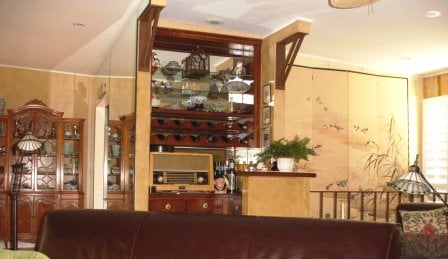
Sofa back looking from left front speaker. Rear JBL SP5 5 ¼" two-ways in lit corner on right . Glass curios do not rattle thanks to Quakehold. Rare 1956 tube RCA "Magic Eye" AM-FM-SW-1-SW2 radio has 3 front speakers and a speaker on each side. Sounds absolutely beautiful!
There was more to my wife's dance though, much more. As she whirled around our dual purpose living/home theater room her side glances were noting that I hadn't changed anything else in the room. Her prized (and highly vibration-prone) porcelain and glass souvenirs, gathered over many years of travels, were still in place on their glass shelves over the wine rack situated just six feet behind our sofa. (Thanks! Quakehold) Plus, she noted, I hadn't removed any of the tchotchkes that reside on our glass coffee table or over our fireplace mantel. Nor had I added any passive absorption or diffuser panels. And best of all, our modest and color-matched in-wall surround speakers hadn't been replaced. They remain as unobtrusive as ever; 5.25" JBL two-ways, color matched and blended into her faux Tuscan-style walls in the only areas she graciously allowed me to place them. The Audyssey acoustic alchemy machine had received the highest recommendation my wife's "golden ears".
Passive acoustical treatments support active Sound Equalization
Custom installation companies who have their own showrooms have usually considered themselves ahead of the game. They can present a well integrated (read: possibly some hidden passive room treatment) and calibrated example of a "typical" A/V Media room with which to sell their expertise.
What this author has found, though, is that you may get the couple to enter an unfamiliar room but still have difficulty in getting the couple to sit down in the sweet spot to listen to and view the marvel that is high performance A/V. And once the female partner sits down she may immediately start thinking about the fight her iPod-generation kids will put up for that same sweet spot when the parents aren't around. In short, the "every seat a good seat" audio goal as taught in John Dahl's and Anthony Grimani's CEDIA courses has been an elusive one at best.
Careful measurement from multiple positions, attempting to "average out" to a best case "flat response" often requires hours. And pros Dahl and Grimani will be the first to point out the adverse effect one parametrically equalized change at one position usually has on another position. Here is the point at which an install can become "stalled". Tweaking time adds up. And calibration to "That's as good as we can get in your room, sir." is not the type of end-of-project scenario any custom installation professional likes to build into an upfront bid.
Fortunately, the latest research in the field of acoustics and psychoacoustics in home surround sound listening areas indicates a great proportion of listening rooms may have a low enough reverberation time (0.3-0.6 seconds) to preclude extensive passive treatment. What this means is that it is still not possible for any active room correction device to operate effectively in sparsely decorated rooms. For example, rooms with all wood floors and few hard surfaced pieces of furniture, as often depicted in ads for A/V gear would most likely raise the reverberation time above the 0.6 second soft threshold.
In my home theater/living room case which is the subject of this Audyssey sound Equalizer review, I would suggest paying close attention to the corner near-wall positioning of the L/C/Rs, the distance to the listening area around the sofa, and the diffusive surfaces that make up both the front and rear hemispheres into which the entire A/V/Room system operates.
Active Room Correction: Audyssey MultEQ Pro - page 2
The Importance of Proper Speaker Placement: Optimizing Any Surround System
When I interviewed Audyssey's Chris Kyriakakis and Tom Holman back in late 2004, the Denon AVR-5805 was just about to become available. At that time, in the University of Southern California's original Immersive Audio Lab, Tom and Chris did a first demo for me of the Audyssey MultEQ XT software that was embedded within a portion of the AVR-5805's Texas Instruments Aureus DSP. Readers of this earlier article (see our Audyssey Labs' MultEQ XT Report ) will recall that the Lab's surround speaker system was set up in the classic THX (5.1) theater layout as prescribed in the ITU 775 standard.
Since that short, exhilarating first experience with Audyssey's MultEQ XT technology I've performed other MultEQ XT-assisted installations, often using Denon AVR-3806 receivers. Putting the systems through their paces after each of my installations has highlighted the extreme importance of adhering, as closely as possible, to the THX/ITU 775 speaker layout recommendations.
So in planning a custom installation I always start with the speakers and consider:
- The chosen loudspeaker's on-axis linearity and the smoothness of their off axis radiation patterns (directivity index)
- Adherence to proper horizontal and vertical placement and
- Positioning (angling toward or away from the listening area)
These are the most vital set up factors necessary to extracting the optimum performance using the Audyssey technologies . If you're a former car audio installer coming over to the home side of the business like I did, these recommendations will probably already make a lot of sense. But if you're coming straight into the ranks of home theater without previous experience in speaker placement perhaps a review is in order.
CEDIA's 100 Core Level Class, "Fundamentals of Home Theater Design" teaches critical design elements for home theaters. Among the most basic of the elements is proper layout of 5.1, 6.1 and 7.1 speaker systems as well their more bass-capable .2 or .4 variations. To get accurate, realistic surround audio performance in any home theater environment it is always best to emulate the monitoring loudspeaker arrangement found at world class sound mixing stages. Here's how the best are set up.
The L/C/Rs: Left/Center/Right
Left and right front speakers should be positioned at ±22.5° to 30° from the 0° center-channel and pointed toward the listener(s). The dialogue-heavy center channel needs to be immediately above or below the video display (or behind a perforated screen) and toed-in toward the listeners' ears.
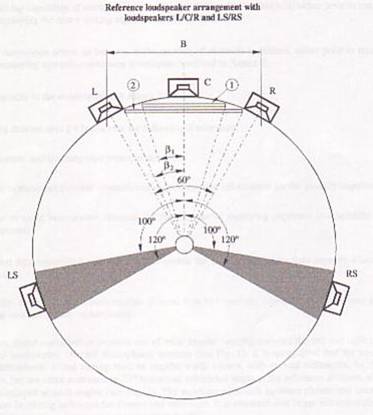
ITU-R BS.775-1 (for 5.1)
Note: The 22.5° L/C/R inner angle (not shown) is an addendum to the ITU standard that was instituted by an agreement between THX and Dolby
Studies have shown that because of the brain/ears' head related transfer function (HRTF) our ability to accurately locate a sound source directly in front of us is an amazing ±1°. And with left-front or right-front sound sources at the prescribed ±22.5° to 30° (and toed-in toward the central listener) we are generally good to ±4°. ) Vertically our top-to-bottom localization acuity remains pretty consistent up to around ~+30°. Higher than +30° or so (as in ceiling mounted L/C/Rs) and the old HRTF starts working again and the left ear can begin to hear direct sounds from the right speaker (because it's no longer completely shielded by your head) and vice versa. Therefore:
- Keep L/C/Rs as close as possible to the same horizontal plane . Panned cars going from left to right across a screen are easy confirmation of the veracity of this L/C/R recommendation.
- L/C/Rs mounted horizontally across the top of the display device will fall under the +30° maximum angle (to the listeners ears) if the recommendations for the +15° max to the screen center (from the viewer's eyes) is maintained.
- With bottom mounted L/C/Rs, point (up, if necessary) toward listening position and make sure that no coffee tables, legs, etc block the path toward the ears.
Mounting any speaker in a cavity, such as the enclosed A/V bookshelf-style units is like asking the speaker to perform from within a trash can. Instead, turn the cavity into a baffle which snuggly surrounds a bookshelf-style speaker. Otherwise cancellation dips, virtually always in the vocal range, will detract from vocal intelligibility. Yes the Sound Equalizer can take out the dips but it is a much more sound installation practice (pun) to build a fixed baffle around the speaker and run a thin bead of silicone around it to seal the bookshelf speaker and baffle to each other. If clients or their kids or their pets move a speaker the whole system can fall out of calibration. Due diligence in securely and properly mounting speakers will limit callbacks.
The Surrounds: Left and Right, Left Rear and Right Rear
Envelopment is a term Tom Holman (creator of THX and Audyssey co-founder) used to describe the mission of the surround speakers when he taught an (H)DTV Audio Seminar back in 1999 for budding surround television professionals. Back then Tom, as first editor for Surround Professional , (a recording industry magazine) stressed that properly executed 5.1 surround speaker placement followed the ITU 775 standard.
In the "optional ¾ loudspeaker arrangement" of the ITU 775 definition left and right (side) and rear surrounds are situated ±60° to 150° from centerline. Curiously, most articles I've seen show only the mid ±110° location for the (side) surrounds (the 5.1 system). Part of the wide, side-placement parameter allowance is again related back to the HRTF. When, for instance, a left surround speaker is placed within these angle parameters only the left ear hears the direct sound from that speaker. The ears/brain directional ability becomes severely degraded because of the loss of higher frequencies in the direct sound to the right ear (which are blocked by the head). So, fortunately for the envelopment goal, human localization ability to the sides is only accurate to ±15° front-to-back (but improves in the vertical direction). Many people have claimed that their side localization capabilities are much more accurate. But when those same people have participated in single-blind testing wherein the side surrounds cannot be seen then the naysayer's true capabilities have reverted back to the wide, ±15° window of localization uncertainty. This is much worse than the nearly ±1° horizontal and ±1.75° vertical localization ability in the front hemisphere.
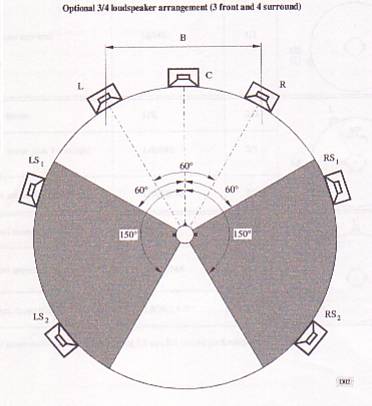
ITU-R BS. 775-1 (for 6.1 & 7.1)
My preference for surrounds, having done dozens of surround set-ups in both homes and recording spaces, is properly designed, true, full range dipoles. It has been my experience though that the use of dipoles requires that the room dimensions plus possibly obstructing (room) design elements and seating locations of the listeners all be determined beforehand. This is because dipoles perform their diffusive envelopment trick by very precise horizontal positioning along the sides (for 5.1) or rear wall (for 6.1/7.1). Dipoles need to project a non-localizable null space throughout the listening area while radiating a positive wavefront to toward an appropriately close front wall and a negative wavefront toward a rear wall. It is this opposing, out-of-phase-with-each- other characteristic of dipoles that, when executed correctly, can pull off a superbly convincing sense of envelopment. Thus, if a high dollar/performance Home Theater is to be constructed from scratch an acoustician experienced in both loudspeaker dispersion characteristics and passive room treatments should be consulted.
In my corner mounted set-up which I'll describe shortly I use bipoles or, to be more accurate, dual monopoles corner-mounted into a faux 90° bipole configuration. Lastly, monopoles pointed not at the listeners but bounced off side and/or rear wall surfaces or pointed over and not at listener's heads are at the bottom of my recommendations when high quality surround is the goal.
Optimal vertical placement of the left and right surrounds is also vitally important to maintain the illusion of envelopment. Vertically, surrounds should be placed at least two feet above the listeners' heads and not pointed toward the listeners but rather aimed so the main wavefront (for monopoles and bipoles) or lack of wavefront (for dipoles) is at a 90° perpendicular angle to the floor and over the listeners heads. Getting too close to the ceiling, which is usually past +15° elevation from the central listener tends to call too much attention to the upper direction of the left and right surrounds. As you'll see, a too-high surround mounting position was one of the major location compromises I had to make due to my particular room layout (and more significant other). In my system, submarine scene envelopment like U-571's depth charges sound just fine but an off camera door-knock sounds positively weird.
Finally, left and right rear surrounds (for 6.1 and 7.1 channel systems) should be placed at ±135° to 150 (ITU 775 rec.) to 170° (in a pinch). Therefore there should be both left and right rear surrounds spaced at least 6' apart, even if they must work from a single rear channel amplifier. When we get to pictures of my personal home set-up it will be seen that dual, 90° opposing monopoles mounted close to the ceiling were my only option. Were I to do it over again I would have spread the two rear surrounds at least four feet out on either side from the 180° rear centerline.
The Problem with Ceiling Mounted Speakers
Note: Only brief mention has been made of in-ceiling speaker mounting either for front L/C/Rs, left/right primary (side) surrounds or single or dual rear surrounds. Ceiling mounted speakers, by their very positioning violate both primary tenets of proper placement; ceiling mounted L/C/Rs (even those angled toward the listeners) cannot provide front localization audio to the video display. The difference between the listener's viewing angle and the ears listening angle is just too great. Plus, remember that ceiling mounting left fronts and right fronts will allow direct sounds from the left speaker to be heard by the right ear and vice versa. It then becomes easier to understand why the much coveted left-right stereo imaging effect goes down the tubes as well; your head isn't in the way. And having your head in the way is what allows the wide soundstage, L/C/R imaging effect work optimally.
Ceiling "surrounds" mounted both to the sides and the rear of the listening area fail to convincingly generate optimal envelopment for the same HRTF reasons. That is, ceiling "surrounds" is almost an oxymoron. They are overhead surrounds whose position is much more capable of being localized because both ears are "in the clear" enough to hear the first wavefront from all surround speakers. Thus, there is no rear separation.
There are of course many jobs which will be signed onto wherein ceiling speakers are an only option. The point in exposing the drawbacks of ceiling speakers here is to warn custom installers against hoping that either of the Audyssey systems can soften or ameliorate the problems that poor speaker placement imposes.
Active Room Correction: Audyssey MultEQ Pro - page 3
Experiences with Audyssey's MultEQ XT Receiver-based Technology in a Dealer Demonstration Room
When the $1299 SRP Denon AVR-3806 (with the Audyssey MultEQ XT system on-board) came out in mid-2005 it was at the same time I was designing and building a new-concept surround demonstration room for one of Ken Crane's Southern California retail outlets. Because of its exceptional sound quality and flexibility, in addition to carrying nearly the same MultEQ XT system as the $6000 AVR-5805 I decided to use three AVR-3806's in this premier surround sound A/V room.
The 19' x 21' Ken Crane sound room featured three quarter-round vignettes placed into the room's three 90° corners. Each quarter-round vignette was capable of demonstrating any combination of four sets of L/C/Rs. There was no fourth corner to the room. Instead, a triangular slice had been designed out of what would have been the fourth corner. This side contained the double 36" entry doors to the sound room from the main sales floor.
The first quarter round vignette featured L/C/R bookshelf speakers (on stands); the second vignette featured L/C/R in-wall or on-walls (plus an on-ceiling system that was requested by Ken Crane's audio buyer). And the third vignette featured floor standing L/C/R tower-style speaker systems.
Two different sets of left/right (side) and left/right rear surround speakers, in-walls and on-walls, formed the envelopment complement for the trio of vignettes. For subwoofer demonstration all twelve systems could be configured to play 5.1, 5.2, 5.3 or 5.4 as well as 7.1, 7.2, 7.3 or 7.4 listening combinations.
The "listening position" was a leather love seat on four heavy duty castors. Under the love seat there was an attached 1" diameter x 12"L pole which was inserted into a 1.25" hole drilled into the cement floor in the center of the room. Thus the sofa could swivel allowing two-listeners to remain at a fixed position around the central axis of the room.
Four sets of L/C/Rs were arrayed across the inner circumference of each vignette with the right and left speaker sets contained between the 22.5° inner angle and the 30° outer angle prescribed by THX/ITU 775.
The Audyssey MultEQ XT system within each of the Denon receivers was calibrated to the central (swiveling) listening sofa using the outermost (±30°) speaker pair. There was a four-piece surround speaker set (for seven channels) for each of the three vignettes. In each vignette the surround speakers chosen for calibration were monopoles. (The retailer did not elect to have dipoles demonstrated.) These monopole sets were pointed toward the listening sofa but aimed at a 90° angle (directly out from the walls) so the speakers fired over the listeners' heads by about 18"-24". High pass filters on all speakers were set to small with the subwoofer-to-satellite splice set to 80Hz.
With twelve 7.1 (or .2 or .3 or .4) surround systems positioned in such a small room the distance from the speakers to the center listening position varied from only 9 to 11 feet in any direction. And this was with both the L/C/R bookshelf and tower speakers shoved right up against the walls of their respective quarter-round vignettes. I wondered, would all of the L/C/R vignettes sound boomy and bloated because of the definitely non-approved-by-audiophiles placement? And how large of a "flat-frequency, acoustic bubble" area around the loveseat would the Audyssey system be able to generate?
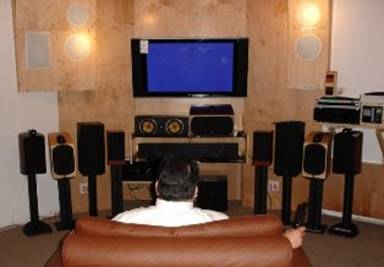
Vignette #1; Bookshelf speakers on stands. In-wall speakers to the left and right of 50" plasma are rear surrounds for vignette #3 in opposite corner. KC salesman sits in swivel chair. Denon AVR-3806 to left of salesman's head inside subwoofer alcove. Source Denon DVD-3910 is on center right next to switcher. Salesman controls switching of L/C/Rs & volume with hand held remote.
When it came time to run the Audyssey MultEQ XT set-up on each of the three vignettes I chose to calibrate using the outside (±30°) L/C/R set for each vignette. Using the AVR-3806's remote I followed the Denon's set-up routine by watching the 50" plasma monitors which were the video centerpiece for each vignette. A small tripod with a boom held the plastic-bodied microphone that comes pre-packaged with each receiver. Not having high hopes for the mic's accuracy I did measurements in six positions around the sofa; one measurement each for the two typical head positions on the sofa; three measurements for persons that might stand behind or to the left and right sides of the sofa; and the final measurement which would simulate an audiophile leaning forward to "better hear" a well imaging system.
The Results: MultEQ XT with and according to THX/ITU 775 Recommendations
I finished running the Audyssey calibration routine on the three Denons late one weekday evening at Ken Crane's. Since it was just before closing there were only a couple customers in the store but the salesmen (who had been without the use of their sound room for weeks) were chomping at the bit to hear the results.
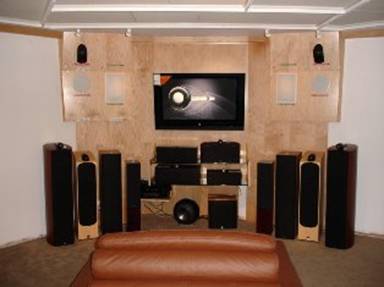
Vignette #3; Floorstanding speakers.
Subs are in alcove under center channels. Denon AVR-3806 is to left bottom center. Ceiling was a combo of absorptive panels and 1"x3" diffraction boards arranged in a helix. Three sets of lights were keyed to vignettes 1, 2 or 3 and highlighted both the main L/C/Rs and the associated surrounds for each vignette. No wall mounted passive treatment was required.
Both the resident audiophile/salesman and one of the long time Ken Crane's sales associates had expressed skepticism that the Audyssey system would be any better than room correction systems found on-board Denon's competitors' receivers. So I invited skeptic #1 to position himself on the swivel sofa while I put the new Ray Charles' "Fever" duet with Natalie Cole in the Denon DVD-3910 DVD player.
Jaws dropped, literally. Skeptic #1 heard a picture-less recreation of a cut he'd used for customer demonstration numerous times before. His eyes opened wider as he scanned the thirty-two surround speakers (six sets of four) and asked if I were playing several sets of surrounds at the same time. "Nope, I replied, "just the single set". "Is that all?", he asked quizzically. He leaned forward. He stood up and walked to within six feet of first the right surround then the left. He sat back down to enjoy the end of the song. Skeptic #1 had been encircled in the seamless MultEQ XT acoustic bubble. One song had elicited one very excited Audyssey convert.
The rest of the store's salesmen also became sold on the exceptional surround sound provided by the near optimal speaker positions in conjunction with room correction Audyssey-style. But in the weeks that followed a couple of events conspired to prevent conversion of more of the chains' sound rooms:
- In this first small sound demo room there were too many systems with too many speakers encircling the space. I strongly believe most peoples' eyes do a great portion of "the listening" in any type of environment, trying to find where the sound is coming from. And the surround envelope was so convincingly seamless I believe customers and salesmen alike thought they were actually listening to a THX-style set up as they'd experienced in the theater wherein all the surround speakers do play.
- Ken Crane's V.P. of Sales added "The customers, in their disbelief of the sound they're hearing had started making excuses to each other to justify what is taking place. Reason's such as "The Ken Crane's sound room looks nothing like our house. If we bought this system it couldn't possibly sound this fantastic in our house."
- Christmas of 2005 marked the explosion of big screen HDTV and the situation was especially acute at Ken Crane's. Given the choice of an easy and quick HDTV sale versus a time consuming add-on sale in an unfamiliar audio room the KC sales guys picked the former.
- The subwoofer switching implementation in the Ken Crane's sound room was never completed. I suspect that we may have run into accurately smoothing frequencies in the first two low bass octaves because the MultEQ XT's low bass center-of-bump-or-dip finding accuracy is just slightly "less than 5Hz" . That translates into a bit better than 1/3rd octave smoothing in the 20Hz to 40Hz band and a bit better than 1/6th octave in the 40Hz to 80Hz band. But Again, I'm guessing here because we were never able to complete the full subwoofer set-up and calibration. That particular Ken Crane's location was to be moved by the time you read this so we'll never know.
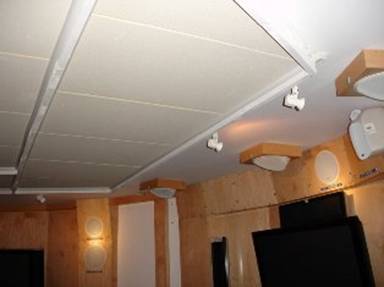
Vignette #2; In-walls, on-walls and in-ceiling. Note 50" plasma tilted down. Thus no reflections from speaker spot lights from the center swivel sofa position. A fireplace mantle had been built into the lower center of this display but the motif was never finished.
Sigh… what's a sound room designer to do? Well, at the same time I was finishing the Ken Crane's sound room there was an EHX show being held at the Anaheim Convention Center . Rushing over to catch the very end of the show I met Mike Thuresson, Audyssey's Installer Program Manager with the first empty chassis, "teaser" version of the Audyssey Sound Equalizer. Mike told me the stand-alone Audyssey unit was still several months from production so I expressed my great interest in doing a full review as soon as a full production sample of the Sound Equalizer became available. In the months preceding the arrival of Audyssey's first name branded unit I purchased a silver version Denon AVR-3806 for my home system to hold me over…
The Low Bass/Room Conundrum: The extreme difficulty in getting the two lower bass octaves "flat " within the entire acoustic bubble of the listening area.
Products that led the way with low bass solutions
Since working as Project Manager and Speaker Designer for Harman International for several years I'd acquired and set-up several of the Infinity subwoofer systems which carried the R.A.B.O.S. single-band parametric equalizer on board. The R.A.B.O.S. system is accurate to 1/20th octave which means it's precise to 1Hz from 20Hz-40Hz and 2Hz from 40Hz to 80Hz.
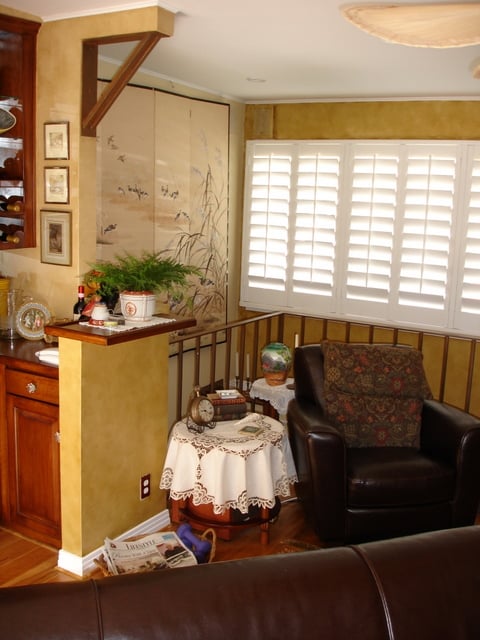
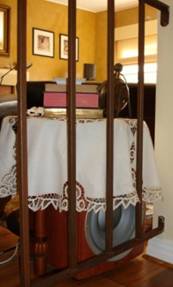
Two shots of Infinity CSW-10 sub. On right, shooting from rear stairwell forward. Center channel Beta 10 just visible through bars. On left, shooting over sofa backward. Sub is under round table. Rear surrounds visible at top center.
 The R.A.B.O.S. system requires point-by-point plotting of low bass frequency points by reading the R.A.B.O.S. CD test tone's sound pressure level from a calibrated, Infinity-supplied SPL meter positioned at the "sweet spot" listening position. Once you've set up a R.A.B.O.S. sub in several different rooms you begin to graphically see how much standing waves can vary in height, width and frequency from one listening position to another and one room to another. And as Dr. Floyd Toole teaches in his "The Loudspeaker and the Room" CEDIA class "To do the bass octaves correctly 1/20th octave parametric equalization (minimum) is necessary".
I like to think of the area under the bass frequency curve as the amount of "work" a room/subwoofer combo is capable of performing. So when I measure, say, a 6dB peak at 54Hz, which is in between the 52Hz and 56Hz frequency tones on the R.A.B.O.S. CD I find that if I try to suppress the offending 54Hz frequency bump using the 52Hz frequency setting I will see suppression at 52Hz but sometimes the SPL at 56Hz will rise!
In other words, because the loudspeaker/room form a single system and work-area-under-the-curve capability remains the same, repetitive, manual frequency curve tweaking can look (on your plotted curve) a bit like you're working with a bowl of Jello. Push down here, reaction over there.
Thus, calibrating a single R.A.B.O.S. sub can be time consuming depending on how much tweaking time you want to put in. But be assured, the results of all this tweaking are immediately noticeable. Great recordings in conjunction with flat bass response (±1.5 dB) unveil immense amounts of separation between bass instruments and allows each instrument to stand, well defined and articulated on its own.
When a second or even three or four subs are added to a home theater set-up, knowing and being able to measure (and actually adjust for) phase differences at the listening position(s) becomes critical. This is because differing room positions for each sub will cause varying and difficult-to-measure relative phase differences as the same correlated bass notes reach the listening position. And it is here where many acoustic measurement neophytes make their mistakes.
With most types of pro-level measurement software like LMS or MLSSA, it is extremely difficult to capture accurate low frequency bass and phase information at a single listening position. Oh, you can set them up to get some type of answer. But in most low bass measurement situations the test software equipment cannot effectively time-window out room effects while gathering information down to 1Hz accuracy at the listening position.
 Subscribe to our newsletter